This report draws on research conducted by the Cedar team and funded by a grant from the New Eurasian Strategies Centre (NEST Centre). The original report was published by the NEST Centre.
Authors: Daria Talanova and L.V.
With the participation of Arnold Khachaturov, Ella Paneyakh, and Ksenia Luchenko.
Infographic: Ksenia Storozheva
Routine, culture, cage: How propaganda returned to Russian schools
Foreword by Pavel Talankin
After the start of the full-scale invasion of Ukraine, many well-educated Russians in their thirties, with financial reserves and the ability to work remotely, packed their belongings and left the country. Hundreds of thousands of young professionals voted against the war with their feet.
One of the main things that distinguishes these thirty-somethings who left is that they never attended Soviet schools, were not exposed to anti-Western propaganda, and did not live behind the Iron Curtain. They grew up and went to school amid the ruins of the Soviet Union, in the relatively free 1990s. It appears that the Kremlin drew its own conclusion from this: it does not want to make the same mistake and lose another generation.
Today, propaganda permeates every level of Russian education. I personally watched the war begin to creep into the small school where I worked. From their first year at school, children were taught to understand what was happening in the world ‘correctly’, to follow ‘traditional values’, and to support ‘our own’ in the war against Ukraine.
How children respond to this propaganda depends largely on the age at which it enters their minds. Older pupils who were already approaching the end of their schooling when the full-scale war began understood perfectly well what was happening – no one needed to explain to them that the state was brainwashing them. For six- and seven-year-olds, however, the war, and talk of enemies and duty to the motherland, became part of ordinary school life from the outset. We will see the real results of this propaganda only when the children who started school during the war reach adulthood.
One teacher who watched my film left a comment that captures exactly what is happening in Russian schools: ‘First it becomes routine, then it becomes culture, and then it becomes a cage you can no longer escape from.’ In a sense, Russian schools have been in this cage before. For many of today’s teachers, who themselves grew up in the Soviet education system, all of this is familiar and readily understood. The difference is that a new cage – Putin’s – has now sprung up almost overnight on top of the old Soviet one.
Pavel Talankin is a teacher and documentary filmmaker who witnessed the transformation of Russian schools into instruments of propaganda from within. While working at a school in Karabash, in the Urals, he filmed compulsory ‘patriotic’ lessons and events, documenting how the war was becoming part of everyday school life. This footage formed the basis of the film Mr Nobody Against Putin (2025), for which Talankin received the Academy Award for Best Documentary Feature in 2026.
Key findings
- The pro-war agenda is embedded in everyday school life long before most children begin to take an independent interest in politics. Though the main target of military propaganda is children aged 9 to 14 (pupils in Years 3–8), when they are most vulnerable to such influence.
- Over four years of war, posts on school social media pages reporting activities related to the ‘special military operation’ increased fourfold, from 74,450 in 2022 to 299,244 in 2025. The surge in pro-war activity began as early as the 2022/23 school year, with an unusual spike in posts in October 2022 – the month after ‘partial mobilisation’ was announced.
- By our estimates, at least 65 per cent of Russian schools – around 26,000 out of 40,000 – are involved in war propaganda.
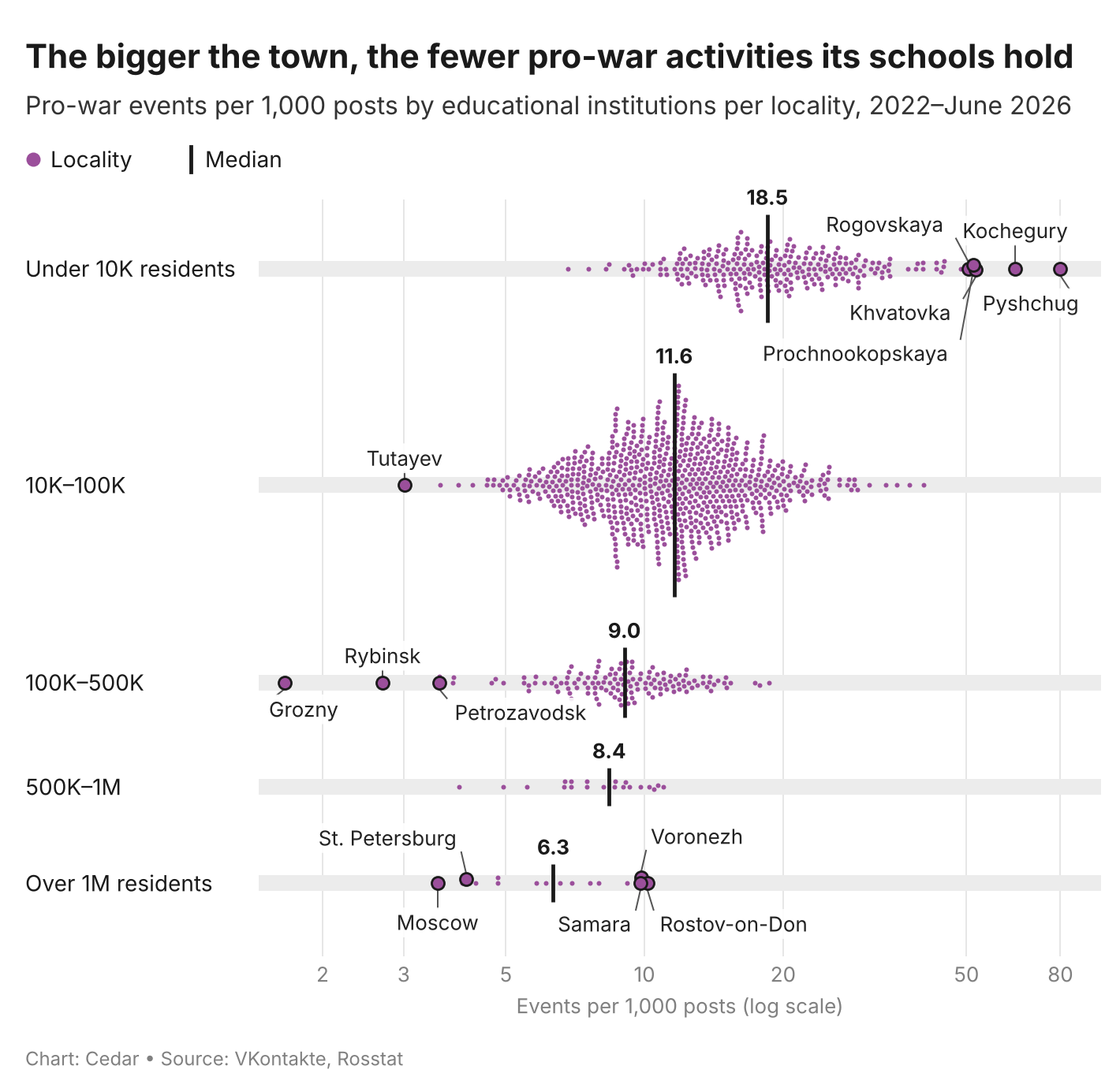
- The intensity of propaganda in schools is linked to locality size but not to the number of war losses. Schools and kindergartens in large cities are significantly less likely to hold events in support of the military. Educational institutions in localities with populations below 10,000 are the most heavily involved in propaganda activities.
- The state sets a mandatory framework and ensures that the war remains a constant presence in schools. Although methodological guidelines regulate the overall approach to propaganda, teachers retain considerable discretion over the specific content of lessons and activities.
- Propaganda in schools often lacks clear political or even moral content. Children are shown military equipment, told about support for military personnel, and encouraged to write letters and take part in fundraising, but they are often given no explanation of why the war began or what its aims are. The ‘special military operation’ is presented not as a political event requiring explanation, but simply as a given.
- Pupils are expected above all to be present and participate, rather than to adopt a particular set of beliefs. Authorities generally do not assess knowledge and learning outcomes from such activities; the expected response is silent participation.
- Constant compulsory participation turns the pro-war agenda into routine. The result is not necessarily a conviction that the Kremlin’s policies are right, but a habit of passively accepting political rituals imposed by the state. This pattern of behaviour is particularly advantageous to an authoritarian political system.
Introduction
Russia began developing a system of ‘patriotic education’ at all levels – from kindergarten to university – even before the full-scale invasion of Ukraine. In 2020, amendments to the Federal Law ‘On Education in the Russian Federation’ made ‘patriotic education’ a compulsory element of educational programmes. In 2022, schools introduced the position of adviser to the headteacher on educational work, a weekly ceremony of raising the flag and singing the national anthem, and Razgovory o Vazhnom (‘Conversations about Important Things’) – weekly lessons devoted to patriotic education and the discussion of social, historical, and political issues. The new advisers organise school events, work with student councils, liaise with children’s and youth organisations, and set up and support local branches of the ‘Movement of the First’.
A separate law established the ‘Movement of the First’ – a patriotic youth organisation, analogous to the Soviet-era Young Pioneers, that provides educational and leisure activities and involves schoolchildren in community projects. Since it was founded, the movement has established 55,000 local branches. This is more than the total number of schools in the country.
Participation in the movement’s activities earns preferential treatment in university admissions. According to the movement, during the 2026/2027 admissions campaign, 111 universities award up to 10 extra points for such participation – the maximum bonus that can be added to Unified State Exam scores for ‘individual achievements’.
Military training returned to the curriculum in 2024 with the introduction of a compulsory subject, ‘Fundamentals of Security and Defence of the Motherland’. It includes a module entitled ‘Military Training: Fundamentals of Military Knowledge’, developed with input from the Ministry of Defence. The subject covers drill, firearms, tactical and military medical training, and drone operation. It is compulsory for pupils in Years 8–11 (aged 14–17) and may be taught in Years 5–7 (aged 11–13) at the school’s discretion.
Pupils in Years 10–11 now use a standardised history textbook with a separate chapter on the ‘special military operation’. It sets out the official interpretation of events approved by the Kremlin, leaving no room for alternative interpretations:
We have to cover this. It is included in the Unified State Exam questions, so we are required to study it and cover it. But, you know, it is a sensitive subject… You have to discuss everything very carefully in class – that is the reality now. You can discuss it, but then you might end up being sent somewhere far away for a very long time because of those discussions.
— Form teacher, Ivanovo
Today, military propaganda extends across the curriculum, extracurricular activities, and even the physical environment of educational institutions. In addition to compulsory Razgovory o Vazhnom lessons and basic military training, pupils must take part in activities that symbolically demonstrate support for the military. For younger pupils, this may involve making crafts and gifts; for older pupils, writing letters to soldiers at the front and meeting veterans of the ‘special military operation’. Schools organise humanitarian aid collections for the front and involve children in making equipment such as camouflage nets and trench candles.
Posters about the ‘special military operation’ and ‘Hero’s Desks’ – school desks displaying the portrait and story of a local resident or former pupil who fought for Russia, including in the war against Ukraine – have become part of the physical environment of educational institutions, turning the war into a constant backdrop and normalising what is happening. Outside regular lesson time, pupils visit military museums and watch ‘patriotic films’.
However, the scale of this system alone tells us little about its effectiveness. To assess how military propaganda operates in Russian schools and how its intended audience receives it, we examined a range of military-patriotic activities in Russian educational institutions between 2022 and 2026 and interviewed participants, including teachers, pupils, and parents. This research provides insight into how propaganda operates in Russian schools, how it affects pupils and staff, and what the authorities have achieved in this area over four and a half years of war.