Jun 2026

Shadow routes: how Russia learned to live with oil sanctions

Since 2022, sanctions have reshaped Russia’s oil trade — but not stopped it. New buyers, new routes, new infrastructure emerged to replace what was lost. By 2026, this system is under growing pressure from multiple directions at once. We look at how it was built, how it holds — and where it’s starting to break down.

Download PDF

This project is implemented in partnership with Dialogue Bureau Foundation and Green Think Tank

Infographics by Ksenia Storozheva

Executive Summary

  • Since 2022, the EU has banned seaborne imports of Russian oil; consequently, Russia's share of supplies decreased to approximately 1% in Q3 2025, down from 29% in Q1 2021. Regarding EU natural gas imports, Russia’s share fell to ~15% in Q3 2025 from ~40% in Q1 2021.
  • In response, Russia reoriented its exports toward Asia: China and India now account for up to ~80% of all Russian oil shipments. India has emerged as the largest spot-market buyer, while China serves as a strategic partner under long-term contracts.
  • Sanctions did not lead to a sharp decline in production, but export costs rose significantly due to discounts, extended logistics, and expenditures on circumventing restrictions, including the formation of a "shadow fleet." The Urals-to-Brent discount increased to ~$15–20 per barrel or higher, compared to ~$3 per barrel prior to 2022.
  • Export revenue declined moderately: in 2023–2024, it fell by only 3.3% compared to 2018–2019 levels. Revenues remain largely determined by global prices and the ruble exchange rate, as sanction-induced shocks proved to be short-term.
  • Concurrently, a "refining loophole" persists: a portion of Russian feedstock returns to the European market via processing and re-export from third countries as petroleum products with formally altered countries of origin. Thus, the EU maintains a link—albeit a limited one—to Russian oil.
  • Turkey and India have become the refining loophole primary hubs. EU petroleum product imports from Turkey increased by 107% year-on-year between February 2023 and February 2024, reaching approximately 13 million tonnes, which accounted for roughly 11% of total EU petroleum product imports during that period. EU petroleum product imports from India rose from $8.7 billion in 2021–22 to $19.2 billion in 2023–24, making India the EU's largest supplier of petroleum products in 2024. While the exact proportion of Russian crude oil used for these shipments cannot be determined, estimates suggest that approximately one-third of the petroleum products exported to the EU from India, and the majority of shipments from Turkey, were produced from Russian feedstock. To resolve this problem, the 18th sanctions package was adopted, tightening EU customs controls.
  • The Russian government's "fiscal maneuver" shifted the tax burden from export volumes to oil production volumes. Budgetary dependence on oil revenues has been reduced (to ~20% in 2025–2027, down from 39% in 2019 and 36% in 2021), as the fiscal load is gradually redistributed to other economic sectors.
  • Following the US imposing sanctions against Russian oil companies, India began refusing feedstock purchases in December 2025; it is expected that intake may decrease by approximately half, to 0.8–1 million barrels per day or lower.
  • Trends of 2025 indicate that sanction pressure will shift toward individual sanctions against shadow fleet vessels and secondary sanctions against Russia's trading partners. Simultaneously, instead of an oil price cap, G7+ countries and the European Commission are discussing a total ban on maritime services for Russian oil exports. In addition to further complicating Russian trade, such measures will facilitate the consolidation of an alternative market outside the control of the G7+ coalition.
  • The US-Israeli war against Iran and the blockade of the Strait of Hormuz resulted in a doubling of Russian crude oil prices between March and May 2026. This drove oil and gas budget revenues up twofold in April and by 1.5 times in March and May relative to the average monthly figures for January and February.
  • Nevertheless, owing to ruble appreciation, oil and gas revenues for January–May 2026 came in at nearly one-third below the figures recorded for the same period in 2025. For the same reason, elevated oil prices will not resolve the fiscal challenges facing the federal budget, whose deficit is projected by the Ministry of Finance to increase by one and a half times over the course of the year relative to the figure stipulated in the budget law.
  • Sanctions targeting petroleum products manufactured in third countries from Russian crude oil have reduced Russian oil companies' export revenues from this category by half.

Introductory Note

While this report was being prepared for publication, developments on the global stage altered the scenario conditions for the world oil market. The US-Israeli military operation against Iran partially offset, in the short term, the impact of sanctions on Russia's oil sector — hydrocarbon prices doubled and a number of export restrictions were lifted. This does not resolve the fiscal challenges facing the Russian federal budget: owing to high military expenditures — which account for 30% of budgetary appropriations — the budget deficit for 2026 will not narrow but is projected to widen by one and a half times, reaching 2.5% of GDP.

From March 2026, immediately following the outbreak of hostilities, the Strait of Hormuz was blockaded — a waterway through which approximately 20% of global oil production is transported — and airstrikes against energy infrastructure across the Persian Gulf region commenced. As a result, Brent crude prices rose by 38% by early June compared to the second half of February, climbing from $68 to $94 per barrel. On individual days in March, April, and May, the benchmark price exceeded $100–110 per barrel.

Accordingly, the FOB price of all grades of Russian crude at all ports doubled relative to pre-war levels in January and February 2026. Urals discounts to Brent remained elevated for shipments from western ports and minimal for those from eastern ports. Specifically, the Urals-to-Brent FOB discount for Baltic and Black Sea loadings averaged $22–25 per barrel in March–May, while select cargoes bound for India and China were sold at a premium of $1.5–6 per barrel. The discount on ESPO-grade cargoes from Pacific ports stood at $2–6 per barrel.

Accounting for these discounts, the average FOB Primorsk price in March–May rose to $90 per barrel from $43 in mid-February, while FOB ESPO climbed to $93 from $55 prior to the war.

A further positive factor supporting Russian crude prices at elevated levels was the partial easing of sanctions. In particular, beginning in March, the United States issued licenses permitting energy buyers to purchase Russian crude, renewing these licenses on a monthly basis. The most recent license was issued on 18 May 2026.

According to Ministry of Finance data, these combined factors drove federal budget oil and gas revenues above pre-war monthly levels. Total oil and gas revenues increased by 50% in March 2026 to RUB 617 billion, twofold in April to RUB 856 billion, and by 64% in May to RUB 679 billion, relative to the January–February 2026 monthly average of RUB 413 billion.

However, two additional factors offset, on an annual basis, the effect of abnormally high energy prices and constrained the revenues of both oil companies and the Russian federal budget.

The first was ruble appreciation: following a brief spike to RUB 87 per dollar in March, the exchange rate strengthened by 8% against the dollar by end-May compared to end-February, reaching RUB 70–72. The second was Ukrainian drone strikes against Russian ports and oil refineries.

From late March onward, Ukrainian Armed Forces (UAF) conducted multiple strikes per week against Russia's largest refineries. As a result, refining capacity equivalent to approximately 23% of Russia's total throughput was taken offline in the first half of May, rising to 29% by end-May — a conservative estimate by one of the report's co-authors that accounts only for confirmed refinery shutdowns and excludes facilities that sustained strikes for which damage data were unavailable. In addition, during spring 2026 the UAF carried out more than ten successful strikes against major oil export terminals, including Primorsk, Ust-Luga, Novorossiysk, and Tuapse, causing recurring disruptions to loading operations.

The strikes created significant sales difficulties for oil companies. Against the backdrop of a 9% year-on-year decline in petroleum product output in April 2026 (per Rosstat), Russian oil production fell by 5% year-on-year in the same month to 8.8 million barrels per day, according to the International Energy Agency (IEA).

As a result, federal budget oil and gas revenues for January–May 2026 contracted to RUB 2.98 trillion, a decline of 30% year-on-year.

A further reason why elevated oil prices in March–May failed to outweigh budget-adverse factors was the scale of subsidy payments to oil-producing companies in the form of refining support, designed to prevent domestic fuel prices from rising above the rate of inflation. Over the first five months of the year, such payments — comprising the fuel damper mechanism, the reverse excise duty, and the investment premium — totalled RUB 955 billion. The peak of RUB 757 billion fell in April and May 2026, precisely because of high prices: the costlier hydrocarbons are on global markets, the larger the compensation the Ministry of Finance pays to oil producers from the federal budget.

A further blow to the Russian budget was dealt by sanctions, introduced from 21 January 2026 onward, targeting petroleum products manufactured from Russian crude in third countries — the so-called refining loophole. These sanctions concern shipments from Turkish and Indian refineries that purchase and process Russian feedstock. According to the authors' calculations based on data from the monitoring organisation CREA, such exports to the sanctioning countries (the EU, the United States, the United Kingdom, Australia, and New Zealand) fell by half in Q1 2026 compared to Q4 2025, to $483 million. Over the full January–May 2026 period, such re-exports totalled $929 million.

The EU introduced new restrictions against a number of Russian oil companies and tankers under its 20th sanctions package in April, is planning additional measures for June, and is also considering a ban on seaborne crude shipments from Russia.

Negative factors likewise predominated for oil company profitability. Rosneft's net profit in Q1 2026 declined by 32% year-on-year to RUB 115 billion, while Gazprom Neft's fell by 3% (other companies have not published their financial statements).

Despite analyst consensus projections placing the average oil price in 2026 at a high of $90 per barrel — implying a Urals price of approximately $70 per barrel — the Russian budget is unlikely to benefit, as the constellation of negative factors is expected to continue dominating. The principal reason Russia has not captured windfall revenues from this conflict is ruble strength. Sustained demand for the national currency is underpinned by several factors: the central bank's elevated policy rate, a trade surplus that, while declining, remains substantial, a high share of foreign trade settlements denominated in rubles (estimated by the CBR at around 60%), and capital controls.

According to economist Dmitry Polevoy, the average annual ruble-to-dollar exchange rate is projected at approximately RUB 75–76, in which case the federal budget deficit could approach 2.5% of GDP — substantially above the 1.6% of GDP stipulated in the budget law for 2026. The Ministry of Finance has already acknowledged this, and is preparing to revise its fiscal parameters upward. Under this scenario, the Ministry of Finance would need to raise an additional RUB 1–1.5 trillion to finance budgetary expenditures, according to Polevoy's estimates.

On the basis of the prevailing factors, therefore, it can be concluded that elevated oil prices will not resolve the expenditure pressures facing the federal budget, nor will they augment financing for the military-industrial complex.

Despite Vladimir Putin's demands that the government achieve economic growth, expert expectations are pessimistic. In mid-May, the government published its updated macroeconomic forecast for 2026, projecting GDP growth of just 0.4%. This figure is barely distinguishable from statistical noise, particularly given that the economy expanded by an equally modest 1% in 2025.

It bears emphasis that even this marginal growth is entirely attributable to the military-industrial complex — an assessment shared even by economists close to the government. According to Rosstat, industrial output in Russia grew by 1.9% in April 2026 year-on-year; however, calculations by the pro-government Centre for Macroeconomic Analysis and Short-Term Forecasting indicate that civilian sectors contracted by 2.9% over the same period.

Against this backdrop, it is unsurprising that the government is discussing cuts to "non-sensitive" federal budget line items — a measure necessary to maintain MIC funding at its current level. All of this supports the conclusion that 2026 may prove a turning point for the Russian economy, at which recession becomes unavoidable.

The Sanctions Regime Against Russian Oil Post-2022

Russia's full-scale invasion of Ukraine in 2022 and subsequent Western sanctions have abruptly altered the export destinations for Russian hydrocarbons. The Russian economy has entered into political and economic confrontation with the EU, the US, and other leading Western economies.

In the spring of 2022, the European Commission (EC) estimated the share of Russian gas in total EU imports at approximately 50%. Furthermore, Russia accounted for approximately 25% of oil imports and 45% of coal imports to the EU. The EU, heavily dependent on Russian energy carriers, sought to eliminate this dependency and develop a strategy for the gradual phase-out of Russian gas, oil, and coal.

This was the primary objective of the REPowerEU plan, first introduced by the EC in May 2022. It included identification of new liquefied natural gas (LNG) importers, acceleration of the development and implementation of alternative gases and renewable energy sources, enhancement of end-user energy efficiency, and support for EU member states with the lowest levels of energy dependency.

In parallel with the development of this plan, the EU initiated sanction pressure on Russia aimed at reducing its hydrocarbon export revenues. As early as February 2022, the Council of the European Union adopted the initial packages of energy sanctions against Russia; by the end of the year, nine packages had been implemented. As of October 2025, the number of packages has reached nineteen.

The EU introduced a total ban on coal imports and established an embargo on seaborne tanker imports of crude oil. Hungary, Slovakia, Bulgaria, and the Czech Republic (the latter two only until 2025) were permitted, by way of exception, to receive Russian crude oil via the Druzhba pipeline. The EU did not prohibit pipeline gas supplies from Russia (these decreased unilaterally following a decision by Gazprom intended to exert pressure on European buyers) and even increased imports of Russian LNG. However, the EU has begun a gradual phase-out of LNG, although a total ban on entering into new long-term LNG supply contracts will only take effect on January 1, 2027. Additionally, the EU introduced measures against the transit of Russian LNG through European terminals.

In one way or another, the EU is actively diversifying its oil and gas suppliers. Based on the results of the first half of 2025, the largest suppliers of pipeline gas were Norway (55% of imports), Algeria (19%), and Russia (10%), while for LNG, the leaders were the USA (57%), Russia (13%), Qatar (8%), and Algeria (7%). In the first three quarters of 2025, the EU's primary partners for oil imports were Norway (14%), the USA (14%), and Kazakhstan (12%).

In January 2026, EU countries approved a plan for a complete phase-out of Russian gas within two years. Under short-term contracts, the purchase of LNG is prohibited starting April 2026, and pipeline gas starting June 2026. Regarding long-term contracts, the ban on LNG will take effect at the beginning of 2027, and on pipeline imports starting from October 1, 2027. Landlocked countries will receive a one-month extension, until November 1, 2027, provided that the country needs to fill gas storage facilities ahead of the winter energy peak season.

In addition to EU member states, other Western nations have joined the sanctions. In 2022, the US, Australia, Canada, the UK, and Switzerland introduced bans on import of all Russian energy resources.

In September 2022, the G7 coalition decided to implement a centralized price cap on oil and petroleum products of Russian origin. It entered into force on December 5, 2022, establishing that Russian crude oil could not be purchased for more than $60 per barrel. In 2025, this cap was made more flexible, fluctuating at a level of 15% below the average global Brent price. According to the original design, the floating cap is to be reviewed every six months to align with current market conditions. As of September 2025, and until the next rate review, the cap was reduced from the initial $60 to $47.6.

Service providers from the Price Cap Coalition (comprising the G7, the EU, and Australia) are prohibited from providing transportation, insurance (including P&I reinsurance), and financing services to actors selling Russian oil at a price exceeding the established cap. By doing this, the specified countries aimed to limit Russia's oil export revenues while maintaining the availability of Russian supplies on the global market to avoid a sharp spike in energy prices.

In January and October 2025, the US added key Russian oil companies—Surgutneftegas, Gazprom Neft, Rosneft, Lukoil, and their subsidiaries—to the Specially Designated Nationals (SDN) list. Consequently, US citizens, companies, and financial institutions are prohibited from engaging in any activity with these entities, including dollar transactions, logistical operations, and insurance of assets and cargo. Concurrently, the EU included these companies in its sanctions lists, restricting their access to European ports and financial services, including insurance and brokerage.

In December 2025, the Council of the European Union and the European Parliament reached an agreement regarding the final phase-out of energy imports from the Russian Federation. LNG imports are scheduled to terminate in December 2026, followed by pipeline gas in September 2027.

Russia’s Adaptation to New Conditions and Circumvention Practices

Prior to the introduction of the sanctions framework and the adoption of the strategy for energy independence from Russia, EU member states were the primary importers of Russian oil and gas. According to the US Energy Information Administration estimates, in the early 2020s, half of all Russian crude oil exports were directed to Europe, whereas by 2025, this share had decreased to just 11%. Only standalone supplies via the Druzhba pipeline remain.

In view of sanctions and a declining demand, Russia was forced to promptly seek new markets for oil and gas. This led to a reorientation of exports toward Asian countries, primarily China and India.

Simultaneously, Russia developed mechanisms to circumvent dollar transactions, which increased the significance of other currencies in Russian oil trade (the yuan, rupee, and dirham). According to the Russian Ministry of Energy, the share of the dollar in oil transactions fell from 55% to 5% between 2022 and 2025; meanwhile, the share of ruble transactions reached 24%, and yuan transactions reached 67%.

Additionally, following the imposition of US sanctions, Russia significantly increased cooperation with small independent refineries in Asian countries, as they remain willing to purchase Russian feedstock despite the risks of secondary sanctions.
An important mechanism for circumventing G7+ sanctions has been the engagement of the so-called shadow fleet, which includes vessels with opaque ownership structures used to conceal the transportation of Russian oil. The shadow fleet makes it possible to transport Russian oil via vessels and services outside the jurisdiction of the G7+ coalition and to sell it outside the scope of the price cap and sanctions. Previously, similar fleets had already been created by other sanctioned countries, such as Venezuela and Iran.

The shadow fleet is necessary even in the case of reorientation of exports to China and India, since the G7+ countries control the majority of global maritime transportation, including key tankers and insurance through P&I clubs (Protection and Indemnity) in the UK, Europe, and the US. Without the use of independent shadow vessels and insurers, Russian oil could not legally circumvent the price cap, as the majority of standard shipments fall under G7+ control. Typically, the shadow fleet includes tankers older than 15 years, which are in poor technical condition and are often not fully insured. In order to conceal the owners, they regularly change flags and documentation, thereby complicating tracking and control.

According to calculations by S&P Global, in March 2023 the Russian shadow fleet numbered approximately 450 vessels, while by September 2025 — 560. At the same time, the entire global shadow fleet is estimated by market participants at 1,200–1,600 tankers, thus Russia can be described as the global leader in gray oil supplies. It should also be taken into account that S&P Global provides some of the most conservative estimates. There are other calculations: the analytical agency Vortexa reports 1,089 tankers, while the Ukrainian Center for Countering Disinformation (CCD), according to its methodology, estimates the size of the Russian shadow fleet at more than 1,200 vessels as of early December 2025.

According to estimates by the European Centre for Research on Energy and Clean Air (CREA), in September 2022, during the introduction of the price cap mechanism, approximately 80% of Russian oil was exported using tankers and services from G7+ countries. By November 2025, only 27% was transported by G7+ tankers, with the remaining volume transported by the shadow fleet. Thus, despite all reductions of the price cap, by 2025 its significance had diminished, since the majority of Russian supplies had shifted from tankers and companies operating under the rules and regulations of the coalition to shadow vessels.

The effectiveness of Western sanctions is hindered not only by Russia’s gray adaptation mechanisms, but also by internal disagreements within the EU. The main opponents of sanctions are the countries of Central Europe, primarily Hungary and Slovakia, traditionally dependent on supplies of Russian energy resources.

The government of Viktor Orbán periodically blocks or attempts to weaken new sanctions packages, seeking the exclusion of those measures that could affect Hungary’s energy security and lead to price increases for its population. In particular, Hungary refused to support plans for the complete cessation of imports of Russian oil and gas by 2027 and expressed its readiness to appeal to the European Court if the EU adopts this ban without the consent of all Member States.

In July 2025, Slovakia blocked the 18th package of EU sanctions against Russia for one month, demanding that the EC develop measures that would guarantee low fuel prices and protection of the country’s automotive sector. The resistance of these countries to sanction Russia is often presented as politically or even ideologically motivated, but in fact has a purely pragmatic motivation. Overall, it does not significantly affect the general vector of EU policy, but it slows down decision-making due to the need to develop compromises.

China and India: New Key Buyers

Western sanctions and the introduction of a price cap on seaborne supplies of Russian oil have significantly reduced the circle of its buyers. As noted above, Russian oil and gas exports have been reoriented toward China and India. Trade relations with them have been structured according to different models.

China relies on long-term contracts and strategic cooperation with Russia, ensuring a stable flow of raw materials and reducing dependence on maritime routes. India, by contrast, focuses on spot transactions, that is, settlements at the current market price with immediate one-time delivery.

China

China is the global leader in terms of crude oil import volumes. Since 2020, China has consistently purchased more than 10 million barrels per day. In 2023, a record level of 11.3 million barrels was reached. China requires very large volumes of oil to meet the country’s demand for transport fuel and feedstock for its growing petrochemical industry and other sectors.

China has been one of the largest buyers of Russian oil since the 2010s, and supplies there consistently accounted for approximately 12–15% of total Russian oil exports even prior to the 2022 sanctions. In 2023, Russia surpassed Saudi Arabia, becoming the largest supplier of oil to China and supplying around 20% of the total average daily volume of crude oil. According to CREA, cumulatively since the introduction of the first oil embargo in 2022, China has purchased 47% of total Russian crude oil exports.

Russian suppliers sign long-term contracts with China’s state-owned oil refineries, which ensure stable demand and predictable supply volumes. In February 2022, Rosneft signed a 10-year agreement for the supply of 100 million tonnes of oil worth $80 billion, which approximately corresponds to 200,000 barrels per day. Moreover, these supplies are delivered via pipelines, which reduces the proportion of the more risky and sanction-prone maritime transportation.

Russia and China have built a parallel financial infrastructure that allows the majority of mutual trade to be conducted in yuan and rubles, outside the SWIFT system. It is replaced by the Chinese payment system Cross-border Interbank Payment System (CIPS), which is fully regulated by the People’s Bank of China and operates exclusively with Chinese yuan. This makes Russia more resilient to Western pressure, but it gives China a new unilateral lever of influence.

In September 2025, Gazprom and China National Petroleum Corporation (CNPC) signed a legally binding agreement on the construction of the Power of Siberia 2 gas pipeline. This document is not a contract and does not contain key commercial terms; however, it formalizes the agreement to continue negotiations and to move to the discussion of the commercial parameters of the future contract.

Despite historically large volumes of energy purchases, in 2025–2026 the growth of Chinese oil consumption compared to previous years is likely to slow. However, oil consumption will still grow faster than its domestic production; therefore, crude oil imports will most likely continue to increase. In the coming years, China also plans to launch and expand several integrated oil refining and petrochemical complexes, which will create additional demand for feedstock.

However, a certain degree of uncertainty was introduced into China’s energy sector by the change in tax policy that occurred in December 2024. The reduction of VAT rebate rates on the export of certain petroleum products negatively affected their competitiveness in the global market. It cannot be ruled out that these changes will ultimately affect the profitability of Chinese oil refineries and their margins, and that China will purchase less crude oil.

US sanctions also continue to affect oil trade between Russia and China. As a result of the inclusion of Rosneft, Lukoil, and their subsidiaries in the SDN sanctions list, Chinese state-owned oil refining companies suspended all direct transactions with them due to increased sanctions risks.

It did not affect the operations of Russian exporters with independent Chinese refineries that are not part of state-owned conglomerates and that control the majority of procurement and processing. According to calculations by analytical platforms, in the short term this reduces the volume of purchases by China by approximately 250–500,000 barrels (out of ~2 million) per day. A temporary disruption in supplies is expected during the period of restructuring logistics chains to circumvent sanctions.

India

India is one of the largest global consumers of energy resources, ranking third in the world in energy consumption after China and the US. At the same time, energy demand in India is growing faster than in other countries — driven by high rates of industrialization, growth in the number of cars, the development of air transport, as well as increasing industrial consumption of plastics and chemical products. Additionally, the country is significantly dependent on imports. For example, domestic oil production covers only about 12% of internal demand, and gas — 51%.

Until 2022, oil supplies from Russia accounted for only about 2.5% of India’s total oil imports. However, in 2022–2023, Russia surged to second place, increasing its share to 21.6%. In 2024, Russia’s share reached approximately 40%, surpassing Iraq, Saudi Arabia, and the UAE in supply volumes. According to the latest CREA estimate, since 2022 India’s cumulative share of Russian crude oil exports has amounted to about 38%, making India the second most important importer for Russia after China. As a result of the increased import volume from Russia and CIS countries, the overall share of Middle Eastern supply to India declined from 60% to 44%.

In India, the government strictly regulates gasoline and diesel prices, so refineries operate with low margins and aim to minimize the cost of purchased crude. Unlike China, Indian importers do not conclude long-term agreements with Russia, instead trading through spot contracts, which provide greater flexibility under changing global market conditions.

Indian refineries began actively purchasing Russian oil primarily due to significant discounts compared to other suppliers, such as countries in the Middle East and West Africa. From April 2022 to April 2023, the average annual price discount on Russian Urals crude on the Indian market amounted to 13.6% compared to alternative crude grades from other supplier countries.

In 2023–2025, a long-term trend of post-sanctions discount reduction was established, with periodic rebounds. From 2023–2024 and into the first half of 2025, the trend toward shrinking sanction-related discounts persisted, which changed with the arrival of Donald Trump’s administration in the White House. In the autumn of 2025, under US pressure and the introduction of import duties on Indian goods, these discounts widened, but did not exceed the 2022 level. In September–October 2025, they amounted to approximately $3–4 per barrel, and by November could rise to around $6 per barrel against Oman/Dubai benchmarks, but no more than that.

According to calculations by Indian Express using Indian customs data, the cumulative Russian discount allowed India to save approximately $12.6 billion over the 2022–2025 period. India also benefits from the significant capacity of its refineries, which are capable of efficiently processing heavy grades of Russian crude, as these refineries were previously configured to handle heavy crude from Africa and the Middle East.

Similarly to the situation with Chinese importers, US sanctions against Rosneft and Lukoil led key Indian refiners—Hindustan Petroleum Corp, Bharat Petroleum Corp, Mangalore Refinery and Petrochemicals, HPCL-Mittal Energy, and Reliance Industries—to begin suspending purchases of Russian oil for deliveries at the end of 2025. Trade with Rosneft and Lukoil accounted for about 60% of India’s oil imports from Russia.

In 2025, Indian buyers imported approximately 1.7 million barrels per day, peaking at up to 2 million barrels per day in mid-2025. By December, India was purchasing 1.4 million barrels per day, and in January 2026 this figure fell further to 1.2 million barrels per day.

In February 2025, Washington and New Delhi agreed on a trade deal, and Trump stated that part of it included a ban on Russian oil for India, both direct and indirect. Following this, according to Reuters sources in oil trading, India’s largest refineries began refusing to accept tankers from Russia scheduled for March and April — and are likely to stop purchasing Siberian crude thereafter.

This could lead, according to the same Reuters sources, to exports to India falling to 0.5–0.6 million barrels per day — that is, three to four times lower than last year’s peaks. In a more optimistic estimate by J.P. Morgan, Indian buyers could maintain purchases at a level of 0.8–1 million barrels per day.

Concentration of Exports in Asia: Opportunities and Risks

The combined share of China and India in Russian oil exports (~80%) demonstrates a high concentration in just two supply directions. According to think tank denkfabrik’s expert, China and India are currently the most logical alternative markets for Russian fossil fuel exports, but cooperation with them carries risks for Russia.

Both countries are heavily dependent on oil imports to meet their enormous domestic demand. At the same time, in trade relations with Russia, China and India have different negotiating powers.

Chinese oil imports are highly diversified among various suppliers, including Malaysia, Saudi Arabia, Iraq, the UAE, Oman, Australia, and others. Russia accounts for about 20% of its imports, making it the largest but not dominant supplier. A similar level of diversification exists for China in gas imports. This position allows the country to negotiate more favorable long-term conditions and prices. For example, negotiations on the Power of Siberia 2 project have largely stalled due to prolonged discussions over supply pricing. Another factor is China’s long-term strategy to develop the power sector to address internal environmental issues.

India’s spot-based purchasing model gives it significant flexibility: it can maneuver between suppliers and avoid long-term commitments, which forces the Russian side to compete through discounts. This model also carries many risks: frequent changes of suppliers may involve additional logistical costs, delays, and supply instability. Switching to imports from other countries can be more expensive and complicated in terms of grade compatibility and volumes, especially if India moves away from heavy Russian crude, which is well suited for its refineries. As a result, Russia remains a convenient source of feedstock for India, and voluntarily losing this market would be disadvantageous in terms of maintaining low domestic fuel prices.

The reduction in the number of sales markets and the increased market power of the largest buyers over supplies make Russia persistently dependent on selling oil at a discount to global prices, especially in competition with Middle Eastern grades on the Indian market. This applies primarily to the Russian Urals brand, which accounts for the majority of Russia’s exports, and to a lesser extent to other export grades. Systemic dependence on discounted sales is further compounded by frequent short-term discount expansions caused by EU and G7 sanctions.

Russian exports in these directions are also threatened by the increasing likelihood of secondary sanctions against India’s and China’s partners, as occurred in the case of the Indian company Nayara Energy and later with several Chinese companies.

In the event of a hypothetical expansion of secondary sanctions, China’s position is much stronger: its enormous market, high political autonomy, and significant volumes of US government bonds held by Beijing make it less vulnerable to pressure from G7+ countries, so the likelihood that China would be “pushed” by secondary sanctions is significantly lower. India, by contrast, is in an asymmetrical trade dependence on the US, and in the event of secondary sanctions could potentially sharply reduce its partnership with Russia — a development already evidenced by the refusal of Indian refineries to accept Russian cargoes at the end of 2025.

If Russia loses or sees a reduction in the share of these markets, it can still restructure its exports to other markets, but it would involve fragmented export flows and increased logistics costs.

Shadow Imports of Russian Oil into Europe

After the first sanctions in 2022, Russia formally lost the majority of its oil and gas exports to the EU, which in December 2022 introduced a full embargo on seaborne crude oil imports. The embargo included a ban on maritime insurance for Russian oil shipments, as well as on the provision of technical assistance, brokerage services, and financing related to the export of Russian oil. In February 2023, petroleum products—including diesel, kerosene, and other fuels—were also included in the ban. Overall, these measures covered approximately 90% of Russia’s previous oil exports to the EU.

However, despite the active introduction of new sanctions measures over the following three years, Russia did not disappear from the European energy infrastructure, partly due to compromises within the EU and partly through mechanisms for circumventing sanctions.

Russian Oil in the EU

The oil embargo did not cover supplies via the Druzhba pipeline to Central and Eastern European countries due to their energy dependence. After the introduction of the embargo, crude oil purchases continued exclusively by Hungary, Slovakia, Bulgaria, and the Czech Republic. The Czech Republic ceased importing Russian oil in April 2025 following the modernization of an alternative pipeline from Italy and Germany. Bulgaria was also temporarily exempt from the embargo but completely stopped importing Russian oil on March 1, 2024.

At present, supplies via the Druzhba pipeline to Slovakia and Hungary remain the only legal direct source of Russian crude oil for EU countries. The share of Russian gas in the imports of these countries remains very significant—around 80–85% in Hungary and 60–70% in Slovakia—with total volumes slightly higher compared to pre-2022 levels. Economists from the Bulgaria-based Center for the Study of Democracy (CSD) note that Hungary and Slovakia could completely abandon Russian gas at moderate cost, since alternative supply routes already exist, but they maintain this dependence due to political choices made by their governments.

CREA estimates the EU’s cumulative share in Russian crude oil exports from February 2022 to November 2025 at 6%.

Additionally, despite the enforcement of the Russian petroleum products embargo in February 2023, the EU continues to import small volumes of certain categories — diesel, kerosene, and fuel oil.

In addition to official direct supplies, there continues to be gray re-export of petroleum products through third countries, primarily Turkey, India, and China. Russian crude oil is sent to local refineries, processed, and the resulting products (diesel, kerosene, fuel oil, etc.) are delivered to the EU. It is important to note that petroleum products imported in this way were not recorded in official EU trade statistics as imports from Russia.

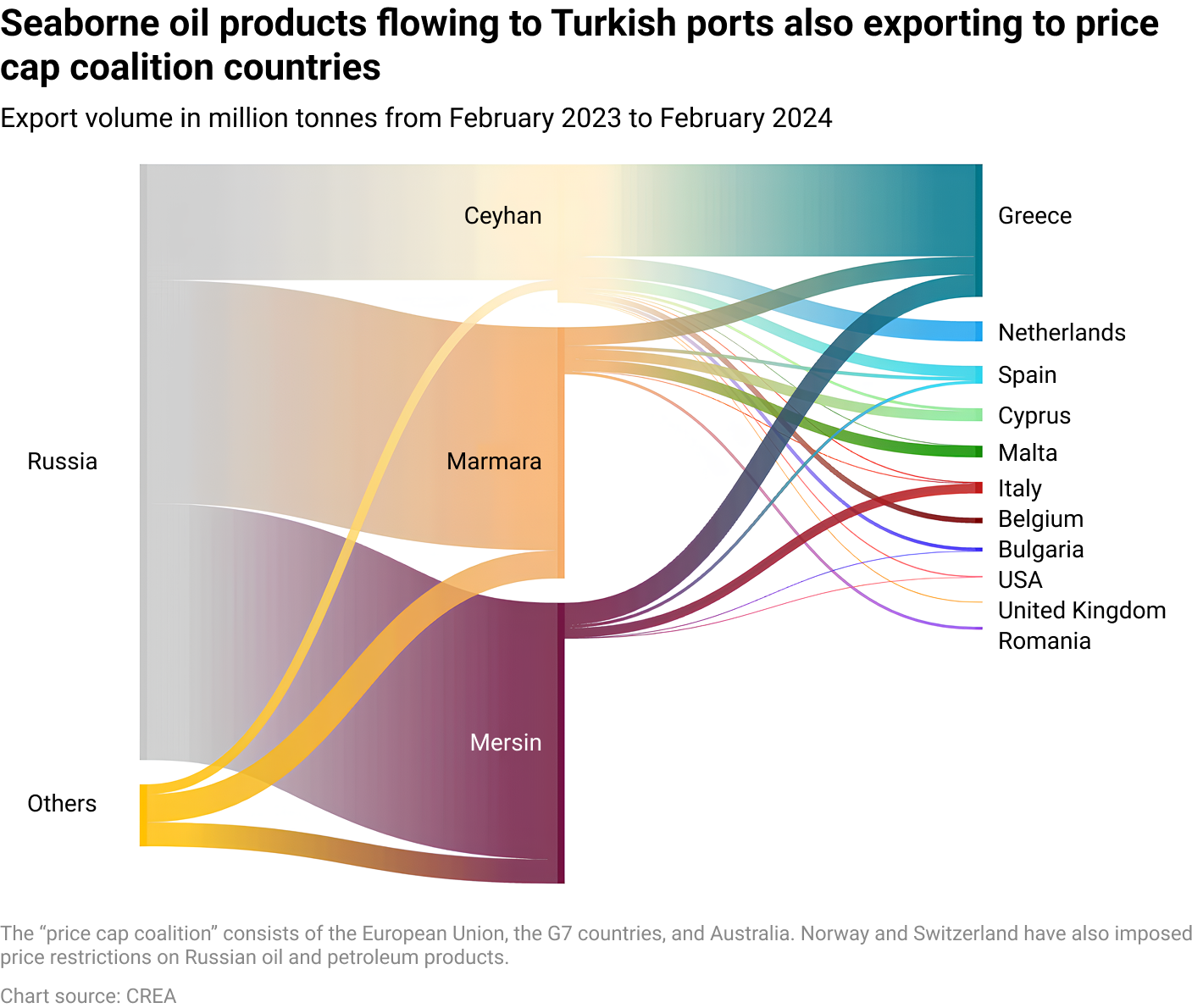
According to reports by CREA and CSD, a significant portion of processed Russian oil reaches the EU from Turkey and India. Between February 2023 and February 2024, the EU imported approximately 13 million tonnes of petroleum products from Turkey — about 11% of total imports for this period. This corresponds to a 107% year-on-year increase and reflects the growing EU dependence on Turkish supplies.

The EU purchased around 5.16 million tonnes of petroleum products from three Turkish ports — Ceyhan, Marmara Ereğlisi, and Mersin. The total value of this import was approximately €3.1 billion. At the same time, Turkey sharply increased its own purchases of Russian petroleum products: during the same period, their volume grew by 105%. A significant portion of these supplies was likely re-exported Russian products, as the indicated ports do not have their own refineries and received 86% of all imported petroleum products (by value) from Russia. Another indicator is that in 2023 domestic Turkish consumption of petroleum products increased by only 8%, while maritime exports from the country grew by 56%.

According to CREA estimates, Turkey imported 24.4 million tonnes of petroleum products from Russia, totaling approximately €17.6 billion. Researchers estimate that these supplies generated around €5.4 billion in tax revenues for the Russian budget.

In addition to Turkey, India has become a key hub for re-export to the EU, simultaneously increasing its purchases of Russian crude oil and supplying more petroleum products to the EU. Prior to 2022, Indian refineries primarily relied on crude from Persian Gulf countries, but with the advent of large discounts on Russian oil, these suppliers moved into the background.

At the same time, the EU is replacing lost Russian supplies with imports from India. The volume of petroleum product exports from India to EU countries more than doubled: from $8.7 billion in 2021–22 to $19.2 billion in 2023–24. As a result, in 2024 India became the largest exporter of petroleum products to the EU, overtaking Saudi Arabia.

A major hub for processing and subsequent re-export of Russian oil is the Gujarat state-located Jamnagar refinery, owned by the Reliance Industries conglomerate. According to Reuters sources, in the first half of 2025, it shipped 28% of its petroleum product exports to the EU and another 10% to the US, with 43% of its crude oil sourced from Russia.

Overall, according to the Washington Post, this refinery has purchased Russian crude worth $33 billion since 2022, which represents approximately 8% of Russian exports over this period. According to CSD estimates, about one-third of all petroleum products exported to the EU were produced from Russian crude. It is assumed that the share of Russian crude in exports from two other refineries is significantly higher: over 70% for Vadinar (Nayara Energy) and around half for the state-owned New Mangalore. Despite the sanctions-related discount, end consumers in the EU do not receive petroleum products at reduced prices, but the marginal profits for Indian refiners increase.

Media reports also describe schemes for re-exporting Russian oil through Georgia: between 2022 and 2024, Georgian exports of crude oil and petroleum products increased more than fourfold, reaching 275,000 tonnes, of which 104,000 tonnes were delivered to EU countries. Simultaneously, imports of Russian crude into Georgia grew multifold, and this increase was not absorbed by local consumption, which may also indicate re-export schemes.

According to CREA estimates, from February 2022 to early December 2025, Russia received approximately €676 billion from oil exports. Of this amount, about €106 billion, or roughly 16%, came from EU countries through direct supplies of crude oil and petroleum products.

In addition, in 2023–2024, Russian oil entered the EU through the so-called refining loophole, the scheme described above. However, due to the lack of precise data on the share of Russian crude at these refineries, it is impossible to accurately assess the significance of the “Russian footprint” in these supplies. According to approximate calculations, the value of Russian crude used to produce petroleum products for subsequent export to the EU from refineries in India, Turkey, China, and Bulgaria amounted to about €2.5 billion in 2023. The largest importers of these petroleum products were the Netherlands, France, and Italy. According to Global Witness estimates, re-exported supplies in 2023 generated approximately €1.1 billion in tax revenues for the Russian budget, or about 1% of total tax revenues from oil sales.

To address the issue of re-exported petroleum products from third countries to the EU, the 18th sanctions package was adopted in July 2025. From January 21, 2026, an import verification mechanism for petroleum products into the EU came into force — it prohibits the purchase or transfer of petroleum products (under European CN code 2710) into the EU if they were produced in a third country using Russian crude oil (CN code 2709 00).

Importers are required to provide EU customs authorities with evidence that Russian crude was not used in the production of the petroleum product. This includes contractual guarantees, refinery certifications, and documentation confirming the origin of the crude oil. National customs and regulatory authorities are entitled to use trade flow data and vessel movement information to verify compliance. Companies found in violation of these rules may be subject to secondary sanctions. The ban does not apply to imports from Canada, the UK, the US, Norway, or Switzerland, as these countries have implemented a full embargo on Russian crude oil imports.

Additionally, the 18th sanctions package cut off imports into the EU from the major Indian refiner Nayara Energy, 49% of which is owned by Rosneft. This move set a precedent: for the first time, a large legal entity of non-Russian origin fell under the EU ban related to the oil embargo against Russia. As a result, Nayara Energy temporarily reduced its processing of Russian crude but by autumn 2025 restored volumes to previous levels, redirecting supplies to Brazil, Turkey, Sudan, and the domestic market.

Meanwhile, Reliance Industries began gradually reducing the use of Russian crude at its export-oriented Jamnagar refinery. In October 2025, the company cut purchases from Russian firms by 13% and increased imports from Saudi Arabia and Iraq from 26% to 40%, continuing to use Russian oil only for the domestic market.

Cost of Sanctions: How Much Russia Is Losing

The sanctions regime and the subsequent sharp expansion of trade volumes significantly increased the discount at which Russian oil traded relative to global benchmarks. As a result, both the Russian budget and oil companies lost billions of dollars.

Urals is Russia’s main export blend, a mixture of light West Siberian crude and heavy high-sulfur crude from Ural and Volga region fields. The price difference between Urals and the global benchmark Brent (or the Brent–Urals spread) is an important indicator of Russian oil profitability. Sanctions and logistical disruptions directly affect the size of the spread, reducing revenue per barrel, which in turn directly impacts the margins and profitability of Russian exporters, and consequently, Russian budget revenues.

Before 2022, almost all Urals exports went to Europe via short routes, so it historically traded close to Brent, with minor fluctuations due to regional supply and demand factors, until sanctions and geopolitical shocks caused the spread to widen. Prior to February 2022, the average Brent–Urals spread rarely exceeded $5 per barrel and typically stood at around $3.

After the introduction of the first restrictions, the Urals–Brent spread immediately reached its peak values — between April and August 2022 and in January–February 2023, it exceeded $30 per barrel. In the first instance, the market was affected by the geopolitical shock of February 2022, and in the second, by the EU’s embargo on seaborne shipments of Russian crude. Since January 2024, the spread has not risen above $15, sometimes even falling to levels comparable to those before 2022. During the period under review, the spread most often widened in response to the oil market’s reaction to sanctions against Russia, followed by subsequent adaptation and a reduction of the discount.

Other Russian export crude grades—ESPO (Eastern Siberia–Pacific Ocean) and Sokol—are of higher quality. ESPO is a light, low-sulfur crude from Eastern Siberia. The majority of ESPO is delivered to China via the ESPO pipeline (VSTO), ensuring stable and low logistics costs. Remaining volumes are shipped through the port of Kozmino, primarily to other Asian countries.

Sokol is also a light, low-sulfur crude extracted from the Sakhalin shelf. It is exported by sea through the port of Korsakov, mainly to Asian countries — China, Japan, and South Korea. Due to its high quality and low sulfur content, Sokol is in demand at Asian refineries oriented toward processing light crude. Before 2022, these grades almost always traded at a premium to Brent; however, their prices have become more volatile, and the premium now persists only periodically.

The large-scale reorientation of exports from the West to the East has also affected total costs, including those associated with more complex logistics and transactions, higher insurance premiums, and risk compensation for counterparties.

Before 2022, Russia supplied crude oil and petroleum products mainly through ports on the Baltic, Black, and Barents Seas directly to European refineries. The proximity of European markets allowed for short delivery routes and low transportation costs. However, with the collapse of the European market, Russia had to increase volumes for much more expensive maritime shipments to China and India. Eastern pipelines, such as ESPO (VSTO) and Kazakhstan–China, while providing stable oil flows over long distances, have limited capacity, making expanded use of maritime routes unavoidable.

This led to an increased demand for tankers capable of transporting crude oil over long distances to Asian countries. The G7+ sanctions regime restricted access to vessels and insurance, making them more expensive to operate and creating a shortage of suitable tankers.

Frequent use of ship-to-ship (STS) transfer schemes became one of the tools to circumvent these restrictions and maintain export flows; however, such operations significantly complicated the supply chain and increased risks related to control, insurance, and financing of cargo shipments.

Companies exporting Russian oil are forced to pay additional premiums to insurance and transportation providers to cover the risks. For example, insurers introduced an extra “war risk” premium for tankers calling at Russian ports on the Black Sea. As a result, insurance costs rose from 1% to 1.20–1.25% of cargo value. For instance, a voyage of a Suezmax-type vessel, frequently used for Russian shipments to India and China, now incurs an additional cost of approximately $200,000 compared to before.

The increased costs from sanctions had little impact on total export volumes but significantly affected Russia’s revenue. Between February 2023 and February 2024, export volumes fell by only ~2%, whereas revenue declined by approximately ~29%. In the period from February 2024 to February 2025, export volumes decreased by ~5%, while revenue fell by only ~3%, indicating a reduction in the sanctions’ impact on income. By the third year of the G7+ sanctions campaign against Russia, the Russian government and exporting companies managed to mitigate the effect of sanctions through switching to alternative buyers, optimizing logistics using the shadow fleet, and gradually minimizing discounts on Russian oil.

Oil Company Revenues and Trade Profitability

The revenue structure from the sale of one barrel of Russian oil shows that a $60 FOB price represents the key breakeven point for Russian oil companies.

For example, consider the situation in 2025. The average price of Urals on FOB–Primorsk terms in Baltic ports during the first 11 months of the year was approximately $55 per barrel. It is worth noting that this price is usually a few dollars below the indicative Urals price calculated by the Ministry of Finance, which takes into account the mineral extraction tax (MET). In November 2025, following the inclusion of Rosneft and Lukoil on the SDN list, the FOB–Primorsk price fell to $45.

From this price, oil companies must cover:

  • MET: $38.5 per barrel in November 2025 (the average MET was $37 per barrel in 2025 and $46 per barrel in 2024)
  • Lifting costs (production cost): approximately $10 per barrel. This figure has risen significantly — in the late 2010s, it was around $5 per barrel.
  • Transportation via the Transneft pipeline: $5 per barrel.

In previous years, when Brent was higher, FOB Baltic prices were also higher — $65 in 2024, $58 in 2023, $73 in 2022, and $68 in 2021.

FOB shipments of ESPO (from Eastern Siberia) and Sokol (Sakhalin) crude traded mostly at a premium to Brent prior to 2022. After the start of the war, these two grades traded mostly at a small discount, with the premium preserved only occasionally. At the end of November 2025, the discount of these two grades to Brent on FOB terms reached $10, a historic minimum.

It is important to note that only 20–25% of Russian oil production pays the full MET rate. Other fields benefit from tax incentives and pay 60% of the rate, while some are completely exempt for a certain period — this applies to the largest Priobskoye field, jointly licensed by Gazpromneft and Rosneft, the high-viscosity crude of Tatneft, and a number of fields beyond the Arctic Circle or with hard-to-recover reserves.

The chart below shows the volume of ruble-denominated revenue that remained with oil companies after tax payments in 2024–2025.

Thus, after October 2025, when sanctions were imposed on Lukoil and Rosneft, and at least until mid-January 2026, those crude oil producers that pay MET at full rates or close to it were operating at a loss, with all the marginal profit from supplying oil to the end buyer captured by traders.

Except for this post-sanctions shock period, oil companies’ revenues followed global prices, and in 2025 they declined due to weak FOB values. During periods of global price growth, for example, spring and summer 2025, as well as throughout most of 2024, trade profitability remained, and margins were positive for both producers and traders.

The effect of the October sanctions will remain in place until companies restructure their supply chains to reduce risks for buyers of dealing with sanctioned entities. Meanwhile, the key question is how long it will take producers to exit the current negative margin situation. Since producer margins depend on the level of MET, their income is linked to lobbying potential and the ability to negotiate preferential rates and tax regimes with the Ministry of Finance. However, oil and gas budget revenues for the 12 months of 2025 fell by 24%, which means the state’s capacity to finance the war declined, making scenarios for tax relief unlikely.

The chart below shows that following the drop in oil prices, the net profits of crude exporters fell significantly. This means that their capacity to invest in maintaining current production, exploring and developing new fields, implementing new technologies, and carrying out technical upgrades and repairs—including refinery repairs damaged by drone strikes of the Ukrainian Armed Forces in 2024–2025—has also declined. Low oil prices not only reduce budget revenues but, combined with high tax withdrawals, also create risks for the future of the industry.

The presented data show that companies’ net profits have fallen dramatically or even turned negative, with Gazpromneft experiencing the largest drop of 37%. In the same period, the Russian budget lost only about 20% of its oil and gas revenues. This indicates that the financial results of producing companies suffer from low oil prices far more than the budget itself.

Separately, the buyer’s costs at the unloading port should be noted. In addition to the trader’s margin, the buyer pays freight of around $10 per barrel, as well as triple insurance — covering the loading port, the unloading port, and the voyage itself (for example, through the Danish Straits). During periods of military escalation, these insurance costs can spike: in November–December 2025, they tripled following drone attacks by the Ukrainian Armed Forces on tankers and port infrastructure in the Black Sea.

Additional costs include banking transactions via multiple intermediaries, especially for cross-currency operations, as well as financial losses from cargo delays caused by ports refusing to accept shipments. These expenses are shared between the trader and the seller according to pre-agreed proportions.

Oil and Gas Revenues of the Russian Budget after 2022

The collected data do not allow for the conclusion that the oil and petroleum product embargo, the G7 price cap, and other sanctions have radically reduced the oil and gas revenues of the budget in the long term.

In 2022, Russian exporters achieved record revenue. In the lead-up to the introduction of the oil embargo, buyers across the market were actively increasing purchases, which led to the average annual Brent price reaching its highest levels since 2018. Additionally, the aggregate revenue of companies was influenced by the fact that Gazprom continued supplying gas to Europe until the fall of 2022, including through the Nord Stream pipelines. Overall, the average two-year export revenue in 2023–2024 declined by only 3.3% compared to the 2018–2019 level.

Under normal market conditions, the oil and gas revenues of the Russian budget fluctuate significantly depending on global market conditions, and the sanctions have only amplified these fluctuations. In 2024–2025, the Russian government introduced changes to the financial policy aimed at reducing the volatility of budgetary revenues. On January 1, 2024, a new taxation model for the oil sector was implemented. The export duty, which under the previous model was levied on the volume of exported oil, was abolished. The main levy became MET, charged directly on the fact of oil production and not dependent on the volume of its export.

One of the objectives of this reform was to reduce the budget’s dependence on the volatility of export revenue. However, since the calculation of MET is tied to the quotations of the main Russian crude grade, Urals, the oil and gas revenues of the treasury remained dependent on the global price as well as the discount of Russian oil relative to the benchmark. As can be seen in the graph below, this dependence is stronger than the correlation between oil and gas tax revenues and the ruble exchange rate: the national currency may appreciate or depreciate significantly, but budget revenues directly reflect commodity quotations.

In addition to reorienting oil and gas levies from export volumes to MET, the government shifted the tax burden to other sources, which has generally reduced the Russian budget’s dependence on hydrocarbon production.

For example, in 2025, a progressive personal income tax (PIT) scale came into force, and the corporate profit tax rate was raised to 25%, while investment deductions were simultaneously expanded. These measures became part of a targeted “tax maneuver” designed to redistribute the fiscal burden from exports toward the domestic tax base and investment incentive instruments, thereby reducing the federal budget’s dependence on the volatility of export oil and gas revenues.

Since 2023, the share of oil and gas revenues in the Russian federal budget has declined significantly amid a rising share of other revenues. In 2018, oil and gas revenues accounted for 46% of the budget, in 2019 — 39%, and starting from 2026, the share of oil and gas revenues in the budget structure is projected at approximately 21–22%.

According to a denkfabrik economist, shifting the fiscal burden from the oil and gas sector to other industries and to households does not create long-term instability for the Russian budget. The budget remains manageable: the deficit is within comfortable limits for Russia (~2.6% of GDP in 2025), and the debt burden remains low, with the government debt currently significantly below 20% of GDP. Under these conditions, the state can continue raising domestic taxes without risking fiscal destabilization, although some tension in the system has noticeably increased.

At the same time, the deficit forecast during 2025 was revised several times, which by itself does not indicate systemic fiscal problems but demonstrates that budgetary planning has become much less predictable. In a situation of budget deficit, a key constraint for Russia remains the lack of access to international capital markets. The government is forced to cover the deficit through the issuance of federal loan bonds, OFZs, on the domestic market, where interest rates have risen significantly. In the first half of 2025, the key rate of the Central Bank reached 21%, and even after its reduction in December 2025 to 16%, it remains very burdensome for the borrower — in the case of OFZs, the state itself, which will pay these interest costs from the budget of future years.

Before the war, budget revenues from energy exports were several times higher than defense expenditures. The decline in the share of oil and gas revenues has shown that the Kremlin is capable of financing the Russian military-industrial complex from other sources, even as military spending increases sharply. For example, from 2018 to 2022, the annual inflow of petrodollars was twice as large as defense spending. However, since 2023, the needs of the military-industrial complex have grown manifold, and taxes from energy production have covered this section of the budget only partially.

In 2025, oil and gas revenues decreased by 24% due to a reduction in the average annual oil price and a strong ruble. This decline was also influenced by the sanctions imposed by the US on four of Russia’s largest oil companies, Rosneft, Lukoil, Gazpromneft, and Surgutneftegaz, as well as the market shock they triggered, which led to an increase in the discount on Russian crude grades.

However, market participants and experts interviewed by the authors of this report unanimously agree that this shock, experienced at the beginning of 2025 after Gazpromneftegaz and Surgutneftegaz had been added to the SDN list, was short-term and was overcome relatively quickly, with Russian suppliers managing to restructure their supply chains to continue exports. They also believe that the consequences of the sanctions imposed in November 2025 on Lukoil and Rosneft can be similarly mitigated. More serious losses to the budget and oil companies are posed by the US requirement for India not to purchase Russian oil: shipments of crude rejected by Indian refineries may be redirected to other buyers, primarily China, at a deeper discount.

Nevertheless, the continuing decline in hydrocarbon prices will further reduce Russian oil revenues. A Reuters survey of 35 economists and analysts indicated that, due to the growing surplus of crude on the market in 2026, the average Brent price is expected to fall to $62.23 per barrel from $68.80 at the beginning of 2025. As a result, the reduction in budget revenues may continue.

Overall, average two-year export revenue in 2023–24 fell by only 3.3% compared to 2018–2019 (official data on such revenue in 2025 has not been published, and estimates vary by tens of billions of dollars).

EU versus Russian Oil: Prospects After 2025

Over the three-year period of the EU’s sanctions campaign against Russian oil exports, the most effective measure has been the embargo on Russian crude oil. It has significantly restricted Russian exporters’ access to profitable and geographically accessible European markets, forcing a reorientation of exports eastward and resulting in a cumulative increase in costs.

The refining loophole, which arose from the processing of Russian oil in third countries, while providing an additional channel for profit from Russian exports, remained minor compared to legal supplies via the Druzhba pipeline and LNG volumes. Final conclusions regarding the effectiveness of EU measures to close the refining loophole can be drawn only some time after the provisions of the 18th sanctions package take effect (January 21, 2026), which introduce mandatory checks on the origin of petroleum products from third countries.

However, as CREA experts point out, the current regulation, which prohibits imports only from net-importing countries of crude oil, leaves an enforcement gap. In their view, for a complete closure of the refining loophole, the EU should introduce import restrictions for refineries that processed Russian oil within the past six months, regardless of the producing country listed in the documentation. To reduce Russia’s revenues, the most effective approach remains a complete cessation of Russian energy exports in line with REPowerEU — including supplies via the Druzhba pipeline, as well as pipeline and liquefied gas.

Events of the past three years demonstrate that the G7+ price cap at $60 per barrel served as a significant sanctions instrument but did not deliver a critical blow to the Russian economy. The reduction of the cap to $47.5 increased pressure on Russian oil exports, but the use of alternative infrastructure largely offset its effect. Currently, EU and G7 countries are discussing a possible replacement for the price cap — a total ban on all maritime services supporting Russian oil exports.

As of November 2025, the share of G7+ tankers in Russian oil shipments remained significant at 27%, so a complete prohibition on the provision and servicing of tankers could become the most radical measure in the entire sanctions period. However, its potential effectiveness and side effects already raise serious concerns among EU maritime states. Representatives from Cyprus and Malta argue that a total ban on maritime services would result in Russian-related oil shipping moving entirely under jurisdictions outside the EU. This would not only further reduce the transparency of shipments but also nullify a key G7+ leverage — the ability to monitor prices, insurance, technical conditions, and shipping routes. (Reuters)

Taken together, both measures—the reduction of the price cap and the potential ban on maritime services—increase Russia’s export costs, but in the long term accelerate the development of parallel infrastructure outside of G7+ control: Russia is likely to continue expanding its shadow fleet, as well as relying on alternative insurance and vessel servicing in third countries.

Thus, the most important front in the sanctions campaign is the creation of new mechanisms to exert pressure on the shadow fleet and the alternative infrastructure supporting its operations. The first vessels of Russia’s shadow fleet were added to the EU sanctions lists under the 14th sanctions package, adopted in June 2024 (Annex XLII of Council Regulation (EU) 833/2014). Since then, the list has been continuously expanded, reaching 557 vessels by the introduction of the 19th sanctions package in October 2025.

Inclusion of vessels on the sanctions list directly prohibits them from entering EU ports, berths, and locks, as well as from accessing insurance, reinsurance, freight, brokerage, and banking services. Consequently, vessels of the shadow fleet that have not yet been sanctioned and operate in the gray zone risk facing not ordinary regulatory restrictions but an effective ban on operations across a significant portion of the market. This makes the operation of such vessels substantially more costly, complex, and less predictable.

It is evident that the expansion of the vessel list will continue into 2026 and that the EU will also continue its efforts against the infrastructure and logistics of the shadow fleet, which will inevitably collide with the interests of third countries.

The trend initiated in 2025 of expanding sanctions against major companies in third countries is also likely to continue. A key precedent was the restrictions imposed on the Indian company Nayara Energy, closely linked to Russian capital, as well as on several Chinese firms. However, such escalation has ambiguous side effects: it isolates these companies from Western suppliers and services, deprives them of choice, and forces them to rely on Russian crude, leading to the consolidation of a trading system alternative to the Western one. At the same time, the leverage of G7+ countries—and of the EU acting alone—is clearly insufficient to compel major players such as India and China to comply with the sanctions policy.

Currently, the EU is increasing pressure on flag states, whose maritime registries often list shadow vessels. Negotiations are underway to revoke registration rights for vessels suspected of sanctions violations and to tighten control over vessel registration. The EU also plans to conclude agreements granting preemptive rights to inspect vessels flying the flags of these countries. This will allow EU countries to lawfully inspect third-country tankers in their waters. Simultaneously, measures targeting the financial and technological isolation of the shadow fleet are being expanded, including restrictions on IT services, software, banking services, and cryptocurrency operations for companies servicing the shadow fleet.

Another significant weakness of the existing sanctions policy is the absence of a clear legal definition of the shadow fleet that could function independently of adding specific vessels to the sanctions list. Experts at Lloyd’s List consider the current definition of the shadow fleet provided by the International Maritime Organization (IMO) to be insufficiently precise. It does not allow officers at maritime control centers to unambiguously identify shadow vessels. Without a clear definition, port authorities are forced to make decisions regarding vessel access at their discretion, increasing the risk of disputed interpretations and inconsistent enforcement of sanctions. Consequently, an important area of work could be the EU’s participation in developing an internationally recognized, universal definition of the “shadow fleet.”

It should also be noted that sanctions pressure on the shadow fleet has significant secondary effects on global tanker logistics. Listing vessels on sanctions lists pushes them out of the white market segment into the shadow market, where they continue to transport Russian and other sanctioned oil outside Western insurance and classification frameworks. This is a stable and systemic process: over the past two years, the rate at which vessels have moved “into the shadows” has exceeded the introduction of new tonnage in certain tanker segments, leading to a shortage of tankers in the official market and increasing freight rates.

According to Veson Nautical, between the beginning of 2025 and now, the price of older VLCCs (Very Large Crude Carriers, 310,000 DWT capacity) increased by approximately 21% (from $33.14 million to $40.25 million), while the time-charter rate (annual lease rate) rose by 30% (from $41,250/day to $53,666/day). This increases pressure on Russia, as replenishing the shadow fleet becomes increasingly expensive, but it also raises costs for global logistics for other exporters and carriers.

At the same time, analysts note that reintegration of vessels back into the white fleet could lead to a market imbalance, particularly in the medium tanker segment Aframax/LR2 (~80,000–120,000 DWT). Since these vessels constitute the majority of the shadow fleet, their return would result in a sharp increase in available tonnage. Under conditions of weak demand, such an influx of vessels would quickly create an oversupply, depressing both freight rates and the market value of tankers in this class.

Bibliography

“A Kremlin Pit Stop: EU Imports EUR 3 Bn of Oil Products from Turkish Ports Handling Russian Oil.” Centre for Research on Energy and Clean Air, May 15, 2024. https://energyandcleanair.org/publication/kremlin-pit-stop-eu-imports-eur-3-bn-of-oil-products-from-turkish-ports-handling-russian-oil/.

Adolfsen, Jakob Feveile, Rinalds Gerinovics, Ana-Simona Manu, and Adrian Schmith. Oil Price Developments and Russian Oil Flows since the EU Embargo and G7 Price Cap. March 27, 2023. https://www.ecb.europa.eu/press/economic-bulletin/focus/2023/html/ecb.ebbox202302_02~59c965249a.en.html.

Aizhu, Chen, Trixie Sher Li Yap, and Florence Tan. “How Sanctions Made a Showpiece Chinese Refinery’s Western Partners Run for the Exits.” Energy. Reuters, November 27, 2025. https://www.reuters.com/business/energy/how-sanctions-made-showpiece-chinese-refinerys-western-partners-run-exits-2025-11-26/.

“Assessing the Impact of Sanctions on Russia’s Shadow Fleet | Kpler - Oct 21, 2025.” Accessed November 29, 2025. https://www.kpler.com/blog/assessing-the-impact-of-sanctions-on-russias-shadow-fleet.

Bockmann, Michelle Wiese. “IMO Assembly Adopts ‘Dark Fleet’ Resolution to Tackle ‘Illegal Operations.’” Lloyd’s List, December 6, 2023. https://www.lloydslist.com/LL1147532/IMO-assembly-adopts-dark-fleet-resolution-to-tackle-illegal-operations.

“Brent / Urals Differential 2022-2025.” Data, Intelligence, and Forecasts for New Energy, Environment, and New Technology, n.d. Accessed November 27, 2025. https://incorrys.com/energy/energy-price-forecast/brent-urals-differential/.

“Brent Crude Oil - Price - Chart - Historical Data - News.” Accessed November 29, 2025. https://tradingeconomics.com/commodity/brent-crude-oil.

Bruegel | The Brussels-Based Economic Think Tank. “Europe’s Russian Oil Embargo: Significant but Not Yet.” November 26, 2025. https://www.bruegel.org/blog-post/europes-russian-oil-embargo-significant-not-yet.

Cahill, Ben. European Union Imposes Partial Ban on Russian Oil. June 8, 2022. https://www.csis.org/analysis/european-union-imposes-partial-ban-russian-oil.

Carnegie Endowment for International Peace. “The Impact of U.S. Sanctions and Tariffs on India’s Russian Oil Imports.” Accessed November 25, 2025. https://carnegieendowment.org/posts/2025/11/the-impact-of-us-sanctions-and-tariffs-on-indias-russian-oil-imports?lang=en.

Carnegie Endowment for International Peace. “Как Россия намерена выиграть газовую войну с Европой.” Accessed December 25, 2025. https://carnegieendowment.org/russia-eurasia/politika/2022/07/what-are-the-kremlins-calculations-in-its-gas-war-with-europe?lang=ru.

Carnegie Endowment for International Peace. “Как Россия намерена выиграть газовую войну с Европой.” Accessed November 29, 2025. https://carnegieendowment.org/russia-eurasia/politika/2022/07/what-are-the-kremlins-calculations-in-its-gas-war-with-europe?lang=ru.

Chabarovskaya, Natalia. “Going Steady: China and Russia’s Economic Ties Are Deeper than Washington Thinks.” CEPA, June 16, 2025. https://cepa.org/comprehensive-reports/going-steady-china-and-russias-economic-ties-are-deeper-than-washington-thinks/.

“China and India Boost Russian Oil Imports: Future Outlook.” Finway, August 6, 2025. https://finway.com.ua/en/china-and-india-significantly-increased/.

“China Imported Record Amounts of Crude Oil in 2023 - U.S. Energy Information Administration (EIA).” Accessed November 24, 2025. https://www.eia.gov/todayinenergy/detail.php?id=61843.

“China’s Crude Oil Imports Decreased from a Record as Refinery Activity Slowed - U.S. Energy Information Administration (EIA).” Accessed November 24, 2025. https://www.eia.gov/todayinenergy/detail.php?id=64544.

COMMUNICATION FROM THE COMMISSION TO THE EUROPEAN PARLIAMENT, THE EUROPEAN COUNCIL, THE COUNCIL, THE EUROPEAN ECONOMIC AND SOCIAL COMMITTEE AND THE COMMITTEE OF THE REGIONS REPowerEU Plan (2022). https://eur-lex.europa.eu/legal-content/EN/TXT/?uri=COM%3A2022%3A230%3AFIN&qid=1653033742483.

“Drop in Petroleum Imports in 2025.” December 19, 2025. https://ec.europa.eu/eurostat/web/products-eurostat-news/w/ddn-20251219-2.

dw.com. “Никто не против. Что ждать от бюджета РФ в 2026 году – DW – 22.10.2025.” Accessed December 29, 2025. https://www.dw.com/ru/nikto-ne-protiv-cto-zdat-ot-budzeta-rf-v-2026-godu/a-74463704.

Editor. “The EU Imported €95.3 Billion Worth of Energy Products in Q1 2025 - Europe-Data.Com.” July 1, 2025. https://europe-data.com/the-eu-imported-e95-3-billion-worth-of-energy-products-in-q1-2025/.

EIA. “India Energy Profile: Third Highest Energy Consumer In The World – Analysis.” Sec. 1. Eurasia Review, February 12, 2025. https://www.eurasiareview.com/12022025-india-energy-profile-third-highest-energy-consumer-in-the-world-analysis/.

“EU Adopts 14th Package of Sanctions against Russia for Its Continued Illegal War against Ukraine, Strengthening Enforcement and Anti-Circumvention Measures - Enlargement and Eastern Neighbourhood.” Accessed December 10, 2025. https://enlargement.ec.europa.eu/news/eu-adopts-14th-package-sanctions-against-russia-its-continued-illegal-war-against-ukraine-2024-06-24_en.

“EU Adopts 19th Package of Sanctions against Russia - Finance.” Accessed December 10, 2025. https://finance.ec.europa.eu/news/eu-adopts-19th-package-sanctions-against-russia-2025-10-23_en.

“EU Gas Flows Tracker.” Accessed December 29, 2025. https://ieefa.org/eu-gas-flows-tracker.

“EU Imports of Russian Fossil Fuels in Third Year of Invasion Surpass Financial Aid Sent to Ukraine.” Centre for Research on Energy and Clean Air, February 24, 2025. https://energyandcleanair.org/publication/eu-imports-of-russian-fossil-fuels-in-third-year-of-invasion-surpass-financial-aid-sent-to-ukraine/.

“EU Imports of Russian Fossil Fuels in Third Year of Invasion Surpass Financial Aid Sent to Ukraine.” Centre for Research on Energy and Clean Air, February 24, 2025. https://energyandcleanair.org/publication/eu-imports-of-russian-fossil-fuels-in-third-year-of-invasion-surpass-financial-aid-sent-to-ukraine/.

Euronews. “Fico Vetoes EU Sanctions on Russia Again and Asks for New Concessions.” 18:30:33 +02:00. http://www.euronews.com/my-europe/2025/10/15/robert-fico-vetoes-again-eu-sanctions-against-russia-asks-for-new-concessions.

Euronews. “Hungary to Sue EU over ‘Brussels Diktat’ to Phase out Russian Energy.” 14:13:23 +01:00. http://www.euronews.com/my-europe/2025/12/03/hungary-to-sue-eu-over-brussels-diktat-to-phase-out-russian-energy.

“Europe Is a Key Destination for Russia’s Energy Exports - U.S. Energy Information Administration (EIA).” Accessed November 21, 2025. https://www.eia.gov/todayinenergy/detail.php?id=51618.

European Commission - European Commission. “Commission Proposes Gradual Phase-out of Russian Gas and Oil Imports into the EU.” Text. Accessed November 29, 2025. https://ec.europa.eu/commission/presscorner/detail/en/ip_25_1504.

European Commission - European Commission. “EU Agrees to Permanently Stop Russian Gas Imports and Phase out Russian Oil.” Text. Accessed December 5, 2025. https://ec.europa.eu/commission/presscorner/detail/en/ip_25_2860.

European Commission - European Commission. “G7 Agrees Oil Price Cap.” Text. Accessed November 21, 2025. https://ec.europa.eu/commission/presscorner/detail/it/ip_22_7468.

European Commission - European Commission. “Joint European Action for More Affordable, Secure Energy.” Text. Accessed November 20, 2025. https://ec.europa.eu/commission/presscorner/detail/en/ip_22_1511.

“European LNG Tracker.” Accessed December 29, 2025. https://ieefa.org/european-lng-tracker.

Forbes.ru. “Дефицит бюджета России за девять месяцев 2025 года достиг 3,78 трлн рублей.” October 9, 2025. https://www.forbes.ru/finansy/547550-deficit-budzeta-rossii-za-devat-mesacev-2025-goda-dostig-3-78-trln-rublej.

Forbes.ru. “Экспортная пошлина на нефть в России обнулится с 1 января 2024 года.” December 15, 2023. https://www.forbes.ru/biznes/502611-eksportnaa-poslina-na-neft-v-rossii-obnulitsa-s-1-anvara-2024-goda.

“Foreign Affairs Council: Press Conference by High Representative Kaja Kallas (on Ukraine) | EEAS.” Accessed December 12, 2025. https://www.eeas.europa.eu/delegations/ukraine/foreign-affairs-council-press-conference-high-representative-kaja-kallas-ukraine_en?s=232.

Galanopoulos, Rebecca. “How US Sanctions Are Driving Dark Fleet Growth and High Tanker Rates.” Veson Nautical, November 24, 2025. https://veson.com/blog/how-us-sanctions-are-driving-dark-fleet-growth-and-high-tanker-rates/.

Global Witness. “EU Purchases of Laundered Russian Oil Worth an Estimated €1.1 Billion to the Kremlin in 2023.” Accessed December 9, 2025. https://globalwitness.org/en/campaigns/fossil-fuels/eu-purchases-of-laundered-russian-oil-worth-an-estimated-11-billion-to-the-kremlin-in-2023/.

IEA. “India - Countries & Regions.” Accessed November 25, 2025. https://www.iea.org/countries/india.

“Import Ban on Refined Products Obtained from Russian Crude Oil - DG Finance.” Accessed November 26, 2025. https://finance.ec.europa.eu/publications/import-ban-refined-products-obtained-russian-crude-oil_en.

“India’s Richest Man Buys $33 Billion in Russian Oil — Risking Trump’s Ire - The Washington Post.” Accessed December 4, 2025. https://www.washingtonpost.com/world/2025/09/23/india-trump-ambani-reliance-russia-oil/.

“India’s Russian Oil Dilemma.” Accessed December 4, 2025. https://thediplomat.com/2025/08/indias-russian-oil-dilemma/.

“Insurers Raise Premiums for Black Sea Tankers as Tensions Mount - Traders | Reuters.” Accessed November 27, 2025. https://www.reuters.com/markets/commodities/insurers-raise-premiums-black-sea-tankers-tensions-mount-traders-2023-08-23/.

Interfax.ru. “Средняя цена Urals в сентябре для расчета НДПИ - $56,82/баррель.” October 3, 2025. https://www.interfax.ru/business/1050757.

John, Jamie, and Lee Harris. “Ukraine’s Black Sea Attacks Trigger Surge in Shipping Insurance Prices.” Financial Times, December 7, 2025.

Katinas, Petras. “October 2025 — Monthly Analysis of Russian Fossil Fuel Exports and Sanctions.” Centre for Research on Energy and Clean Air, November 13, 2025. https://energyandcleanair.org/october-2025-monthly-analysis-of-russian-fossil-fuel-exports-and-sanctions/.

Kpler, dir. G7’s Proposed Russian Oil Shipping Ban Will Push Trade Deeper into the Grey Market - Muyu Xu, Kpler. 2025. 05:14. https://www.youtube.com/watch?v=_beWwKLNBG0.

Lenta.RU. “Стало известно о проблемах с «Силой Сибири-2».” Accessed December 1, 2025. https://lenta.ru/news/2025/10/07/problem/.

Meade, Richard. “Shadow Ports: How Cutting off Russia’s Access to Maritime Trade Could Help Sanctions Have Real Impact.” Lloyd’s List, November 27, 2025. https://www.lloydslist.com/LL1155677/Shadow-ports-how-cutting-off-Russias-access-to-maritime-trade-could-help-sanctions-have-real-impact.

“Moscow’s Oil Helped India Save $12.6 Billion in 39 Months; Presumptive Savings Likely Much Higher as Russian Oil Imports Kept Global Prices in Check.” The Indian Express, September 2, 2025. https://indianexpress.com/article/business/india-russia-oil-savings-imports-global-trade-prices-10223321/.

Mukherjee, Anushree Ashish. “Swelling Supply to Keep Oil Prices under Strain in 2026.” Energy. Reuters, November 28, 2025. https://www.reuters.com/business/energy/swelling-supply-keep-oil-prices-under-strain-2026-2025-11-28/.

“Navigating Sanctions - Laundered Russian Oil Finds Its Way Back to Europe from India.” December 2024. https://csd.eu/publications/publication/navigating-sanctions/.

Niranjan, Ajit. “European Imports of Liquefied Natural Gas from Russia at ‘Record Levels.’” Environment. The Guardian, January 9, 2025. https://www.theguardian.com/environment/2025/jan/09/european-imports-of-liquefied-natural-gas-from-russia-at-record-levels.

Nov 11, Tsvetana Paraskova-, 2024, and 6:10 Am Cst. “India’s Fuel Exports to the EU Soar Due to Refining Loophole in Russia Sanctions.” OilPrice.Com. Accessed December 4, 2025. https://oilprice.com/Latest-Energy-News/World-News/Indias-Fuel-Exports-to-the-EU-Soar-Due-to-Refining-Loophole-in-Russia-Sanctions.html.

Nov 25, Natalia Katona-, 2025, and 7:00 Pm Cst. “India’s Nayara Energy Defies Sanctions With Record Russian Intake.” OilPrice.Com. Accessed December 4, 2025. https://oilprice.com/Energy/Crude-Oil/Indias-Nayara-Energy-Defies-Sanctions-With-Record-Russian-Intake.html.

OSW Centre for Eastern Studies. “The G7 Has Reached a Political Deal Concerning a Price Cap on Russian Oil and Petroleum Products.” September 6, 2022. https://www.osw.waw.pl/en/publikacje/analyses/2022-09-06/g7-has-reached-a-political-deal-concerning-a-price-cap-russian-oil.

Payne, Julia, Jonathan Saul, and Maria Cheng. “Exclusive: EU, G7 Weigh Ban on Maritime Services for Russian Oil Exports, End to Price Cap.” Energy. Reuters, December 6, 2025. https://www.reuters.com/business/energy/eu-g7-weigh-ban-maritime-services-russian-oil-exports-end-price-cap-2025-12-05/.

Raghunandan, Vaibhav. “November 2025 — Monthly Analysis of Russian Fossil Fuel Exports and Sanctions.” Centre for Research on Energy and Clean Air, December 11, 2025. https://energyandcleanair.org/november-2025-monthly-analysis-of-russian-fossil-fuel-exports-and-sanctions/.

“Refining Loophole Widens: 44% Increase in Sanctioning Countries Imports of Oil Products from Russian Crude in 2023.” Centre for Research on Energy and Clean Air, February 19, 2024. https://energyandcleanair.org/publication/refining-loophole-widens-44-increase-in-sanctioning-countries-imports-of-oil-products-from-russian-crude-in-2023/.

Reuters. “Bulgaria Replacing Russian Crude with Oil from Kazakhstan, Iraq, Tunisia.” Commodities. January 12, 2024. https://www.reuters.com/markets/commodities/bulgaria-replacing-russian-crude-with-oil-kazakhstan-iraq-tunisia-2024-01-12/.

Reuters. “Russian Oil Discounts Widen as Indian and Chinese Refiners Cut Purchases, Sources Say.” Energy. November 6, 2025. https://www.reuters.com/business/energy/russian-oil-discounts-widen-indian-chinese-refiners-cut-purchases-sources-say-2025-11-06/.

Reuters. “Turning Screws on Russia Should Not Impact Legitimate Maritime Sector, Say Cyprus and Malta.” Business. December 11, 2025. https://www.reuters.com/business/turning-screws-russia-should-not-impact-legitimate-maritime-sector-say-cyprus-2025-12-11/.

Riddle Russia. “When Oil Becomes «Georgian».” Accessed November 29, 2025. https://ridl.io/when-oil-becomes-georgian/.

“Russia and China Sign 10-Year US$80 Billion Oil Supply Agreement.” Accessed November 24, 2025. https://www.leaglobal.com/resource/russia-and-china-sign-10-year-us-80-billion-oil-supply-agreement.html.

“Russia Fossil Tracker – Payments to Russia for Fossil Fuels since 24 February 2022.” Accessed December 9, 2025. https://www.russiafossiltracker.com/.

“Russia Interest Rate.” Accessed December 29, 2025. https://tradingeconomics.com/russia/interest-rate.

“Russian Urals Discount Widens to $6/Bbl after US Sanctions.” The Financial Express, November 25, 2025. https://www.financialexpress.com/policy/economy-russian-urals-discount-widens-to-6bbl-after-us-sanctions-4055703/.

“Russia’s Oil Exports Have Decreased Modestly since 2022, Shifting toward Asia - U.S. Energy Information Administration (EIA).” Accessed November 21, 2025. https://www.eia.gov/todayinenergy/detail.php?id=65885.

“Sanctions on Energy - European Commission.” Accessed November 21, 2025. https://commission.europa.eu/topics/eu-solidarity-ukraine/eu-sanctions-against-russia-following-invasion-ukraine/sanctions-energy_en.

Saul, Jonathan. “Shadow Tanker Fleet Grows More Slowly as Western Sanctions Target Russian Oil.” Energy. Reuters, August 13, 2025. https://www.reuters.com/business/energy/shadow-tanker-fleet-grows-more-slowly-western-sanctions-target-russian-oil-2025-08-13/.

S&P Global Commodity Insights. “China’s VAT Rebate Reduction to Discourage Clean Oil Product Exports in 2025.” November 18, 2024. https://www.spglobal.com/commodity-insights/en/news-research/latest-news/refined-products/111824-chinas-vat-rebate-reduction-to-discourage-clean-oil-product-exports-in-2025.

S&P Global Commodity Insights. “FACTBOX: Shadow Fleet Expands to Maintain Sanctioned Oil Flows.” March 9, 2025. https://www.spglobal.com/commodity-insights/en/news-research/latest-news/crude-oil/090325-factbox-shadow-fleet-expands-to-maintain-sanctioned-oil-flows.

S&P Global Market Intelligence. “Russia’s Shadow Fleet - Understanding Its Size, Activity and Relationships.” March 17, 2023. https://www.spglobal.com/market-intelligence/en/news-insights/research/russias-shadow-fleet-understanding-its-size-activity-and-relat.

Team, The Editorial. “Shadow Fleet Keeps Expanding despite Sanctions and Regulations.” Shipping. SAFETY4SEA, August 6, 2025. https://safety4sea.com/shadow-fleet-keeps-expanding-despite-sanctions-and-regulations/.

“Telegram: View @CenterCounteringDisinformation.” Accessed December 11, 2025. https://t.me/CenterCounteringDisinformation/16438.

“The Last Mile: Phasing Out Russian Oil and Gas in Central Europe.” Centre for Research on Energy and Clean Air, May 15, 2025. https://energyandcleanair.org/publication/the-last-mile-phasing-out-russian-oil-and-gas-in-central-europe/.

“The New Face of Maritime Risk: How Deceptive Shipping Practices Are Redefining Compliance | Kpler - Nov 10, 2025.” Accessed November 29, 2025. https://www.kpler.com/blog/maritime-risk-deceptive-shipping-practices-redefining-compliance.

The Times of India. “India’s Russian Oil Imports Hit 11-Month High in June; Refiners Stock up amid Middle East Conflict: Report.” July 13, 2025. https://timesofindia.indiatimes.com/business/india-business/indias-russian-oil-imports-hit-11-month-high-in-june-refiners-stock-up-amid-israel-iran-conflict-report/articleshow/122416981.cms.

“Timeline - Packages of Sanctions against Russia since February 2022 - Consilium.” Accessed November 21, 2025. https://www.consilium.europa.eu/en/policies/sanctions-against-russia/timeline-packages-sanctions-since-february-2022/?

Todorov, Mihail. “Tanker Market Supply Scenarios for 2025 and 2026.” AXSMarine, December 18, 2024. https://public.axsmarine.com/blog/tanker-market-supply-scenarios-for-2025-2026-risks-of-oversupply-amid-shadow-fleet-uncertainty.

“Top 15 Crude Oil Suppliers to China 2024.” Accessed December 1, 2025. https://www.worldstopexports.com/top-15-crude-oil-suppliers-to-china/.

U.S. Department of the Treasury. “Treasury Sanctions Major Russian Oil Companies, Calls on Moscow to Immediately Agree to Ceasefire.” February 8, 2025. https://home.treasury.gov/news/press-releases/sb0290.

“U.S. Joins Canada In Banning Imports Of Russian Oil And Gas; EU Announces Plan To Drastically Reduce Reliance On Russian Gas; United Kingdom Will Phase Out Imports Of Oil And Gas From Russia By End Of 2022; Australian Oil Companies Stop Purchasing Russian Oil.” WITA, n.d. Accessed November 21, 2025. https://www.wita.org/blogs/banning-russian-oil-gas/.

“US Sanctions on Rosneft and Lukoil to Cause Short-Term Disruptions, Not Structural Change | Kpler - Oct 28, 2025.” Accessed November 24, 2025. https://www.kpler.com/blog/us-sanctions-on-rosneft-and-lukoil-to-cause-short-term-disruptions-not-structural-change.

“US Sanctions on Russian Oil Giants Send Shockwaves Across China - Bloomberg.” Accessed December 29, 2025. https://www.bloomberg.com/news/articles/2025-10-23/us-sanctions-on-russian-oil-giants-send-shockwaves-across-china?embedded-checkout=true.

Verma, Nidhi. “India Poised to Sharply Cut Russian Oil Imports after Sanctions, Sources Say.” Energy. Reuters, October 23, 2025. https://www.reuters.com/business/energy/indian-refiners-review-russian-oil-contracts-after-us-sanctions-source-says-2025-10-23/.

Verma, Nidhi. “Russia-Backed Indian Refiner Condemns EU Curbs, Weighs Legal Options.” Energy. Reuters, July 21, 2025. https://www.reuters.com/business/energy/russia-backed-indian-refiner-condemns-eu-curbs-weighs-legal-options-2025-07-21/.

“World Economic Outlook (October 2025) - General Government Gross Debt.” Accessed December 5, 2025. https://www.imf.org/external/datamapper/GGXWDG_NGDP@WEO.

Yahoo Finance. “China’s State Oil Firms Halt Russian Oil Buys after Sanctions, Reuters Reports.” October 23, 2025. https://finance.yahoo.com/news/china-state-oil-firms-halt-135310118.html.

“Доходы Федерального Бюджета \ КонсультантПлюс.” Accessed November 29, 2025. https://www.consultant.ru/document/cons_doc_LAW_515953/5361d6be967f2e1f76af03a8f5474dfdacf09ee1/.

“Игорь Юшков: 85-90% Нефтяного Экспорта РФ Направляется в Индию и Китай.” Accessed December 1, 2025. https://www.angi.ru/news/2927346-%D0%98%D0%B3%D0%BE%D1%80%D1%8C%20%D0%AE%D1%88%D0%BA%D0%BE%D0%B2%3A%2085-90%20%20%D0%BD%D0%B5%D1%84%D1%82%D1%8F%D0%BD%D0%BE%D0%B3%D0%BE%20%D1%8D%D0%BA%D1%81%D0%BF%D0%BE%D1%80%D1%82%D0%B0%20%D0%A0%D0%A4%20%D0%BD%D0%B0%D0%BF%D1%80%D0%B0%D0%B2%D0%BB%D1%8F%D0%B5%D1%82%D1%81%D1%8F%20%D0%B2%20%D0%98%D0%BD%D0%B4%D0%B8%D1%8E%20%D0%B8%20%D0%9A%D0%B8%D1%82%D0%B0%D0%B9/.

“Изменения в Налоговом Законодательстве с 2025 Года - Новая Система Налогообложения с 2025 г.” Accessed December 5, 2025. https://www.garant.ru/1c-wiseadvice/guide/izmeneniya-v-nalogovom-zakonodatelstve-s-2025-goda/.

Кезик, Ирина. “Зеленый не горит: расчеты за российскую нефть в долларах упали до 5%.” Известия, September 16, 2025. https://iz.ru/1955149/irina-kezik/zelenyj-ne-gorit-raschety-za-rossijskuyu-neft-v-dollarah-upali-do-5.

Коммерсантъ. “Дисконты на своей волне.” November 12, 2025. https://www.kommersant.ru/doc/8194584.

“Нефтегазовые Доходы Бюджета РФ Снизились в Ноябре 2025 Года.” Accessed December 9, 2025. https://www.kommersant.ru/doc/8251887.

Тарасовский, Юрий. “Индийские НПЗ сэкономили $12,6 млрд на российской нефти — Forbes.ua.” September 1, 2025. https://forbes.ua/ru/news/indiyski-npz-zekonomili-126-mlrd-na-rosiyskiy-nafti-zavdyaki-znizhkam-01092025-32323.