Nov 2025

What makes one a fan of RT France?

RT France, the banned French arm of Russia’s state-funded TV network, still attracts a highly engaged audience, with a growing share of African users. Network analysis of its followers on X and Facebook links them to far-right politicians, anti-vaccine and conspiracy communities. Interviews show that across these groups, viewers share distrust of “mainstream” media and an affinity for RT’s image as a censored outsider.

Research by: Gulnara Zakharova, Alesya Sokolova

Key Findings

  • After Russia’s invasion of Ukraine, the EU banned the state-funded TV channel RT in March 2022. “Militant” audiences mobilized against the ban using the hashtag #soutienRTFrance and a Change.org petition. Despite the ban, RT France still attracts significant online engagement
  • On X, their most-followed accounts include far-right sources, with far-left figures, anti-vaccine activists, and conspiracy theorists also present.
  • Interviews reveal a strong sense of shared marginalization and exclusion from "mainstream" public discourse among RT France’s viewers. Since February 2022, RT France has gained more African followers on X and Facebook — driven by its strategic outreach to the continent, shifting political dynamics, and heightened interest following the EU ban.
  • French far-right and African audience segments connect through shared traditional values, with some African viewers also following French far-right personalities.

Introduction

RT France — formerly Russia Today — is a French-language branch of the Russian state-funded TV network RT. Launched in December 2017, it was banned in the European Union in March 2022 for spreading Kremlin-backed narratives and misinformation. While critics see it as a propaganda tool, the channel presents itself as “an alternative” to the "mainstream" media.

Although RT’s content and strategy have been widely studied, little attention has been paid to its audience and their reasons for following it. Despite the EU ban, RT France has maintained a close-knit, global community. Opposition to the ban emerged quickly, with the hashtag #soutienRTFrance and a Change.org petition signed by more than 50,000 people.

Today — removed from YouTube, Facebook, and Instagram — the channel still has a substantial online presence: 82,465 followers on Telegram (as of June 24, 2025), 185,607 on X, 19,186 subscribers on the less-moderated video platform Odysee, and over 544,000 monthly visits to its website (May 2025, SimilarWeb data). Its audience includes not only French viewers at home and abroad but also French speakers from across Europe, Africa, and beyond.

This study examines who these viewers are, why they follow RT France, and why African audiences have grown in recent years. The findings draw on network analysis of RT France’s followers on X and Facebook, as well as 63 interviews with its audience. For X, one dataset includes the most followed pages of users who posted the hashtag #soutienRTFrance, and another — of users who commented RT France’s most popular tweets. For Facebook, we studied a dataset of RT France commentators, and a dataset of “Super Fans”, as flagged by Facebook’s badge system.

It is important to note that our data reflects a “vocal minority” — those who actively interact with RT France’s content or follow it on social media—rather than the entire audience.
Most interviewees were recruited via X. Using Minet, a Python-based web-mining tool, we identified users who had posted with the hashtag #soutienRTFrance after the channel’s ban—2,447 tweets by 1,403 unique users as of June 15, 2022.

We also monitored engagement with RT France’s most popular tweets for a year after the ban. Data was collected daily from February 28 to March 13, 2022, then weekly, and again daily from February 28 to March 13, 2023, to capture changes over time. This second X dataset included 1,238 unique users.

On Facebook, we followed a similar approach, collecting comments daily and weekly (6,382 unique users). We also identified 1,034 “Super Fans” — users most active in engaging with RT France content, as flagged by Facebook’s badge system (though its exact criteria are unclear).

Semi-structured interviews with X users were conducted between April and October 2022; interviews with Facebook users took place in April and May 2024. Additional respondents were recruited via RT France’s Telegram channel and website. Of the 63 interviewees, 15 were based in African countries.

For X and Facebook users, we collected data on country of residence, gender (in the case of X, inferred from names using the OpenAI API), and the pages or accounts they followed. We then used network analysis to identify interest-based communities.

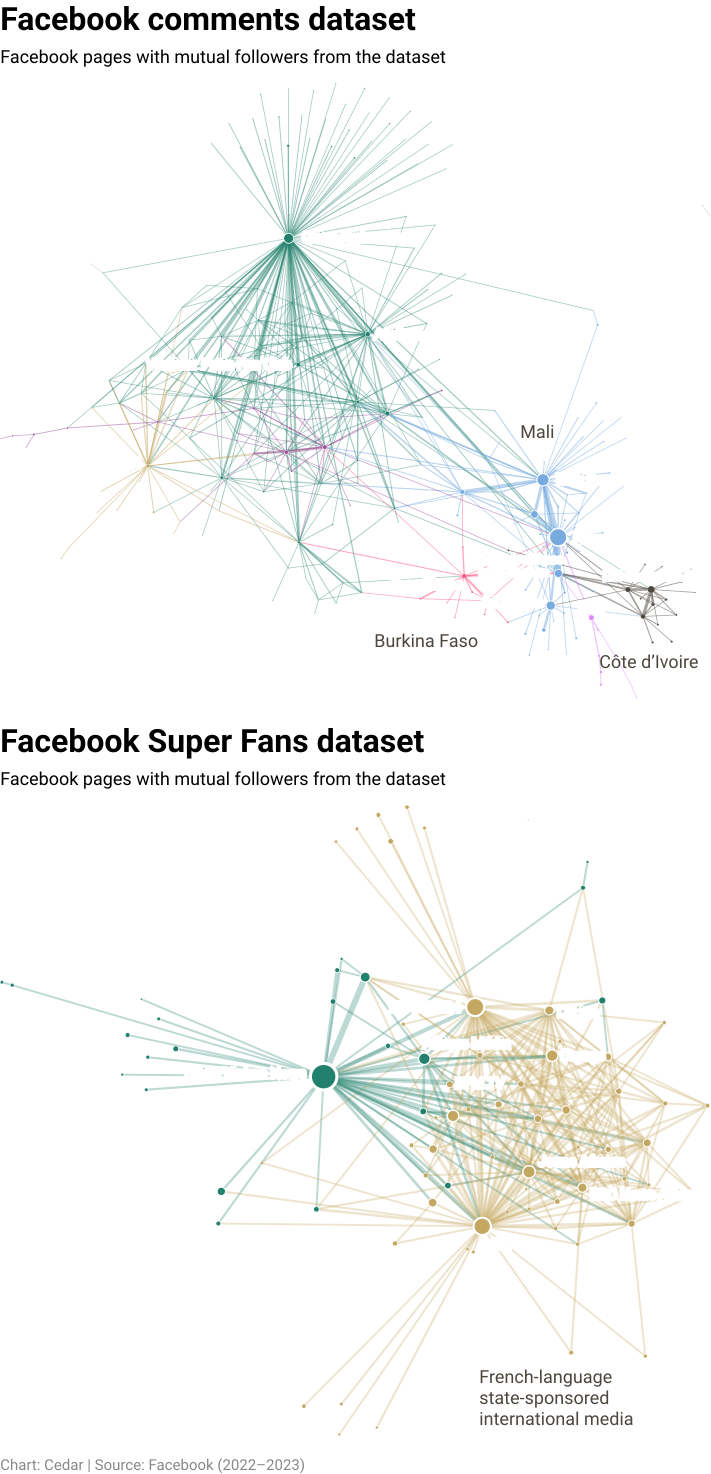
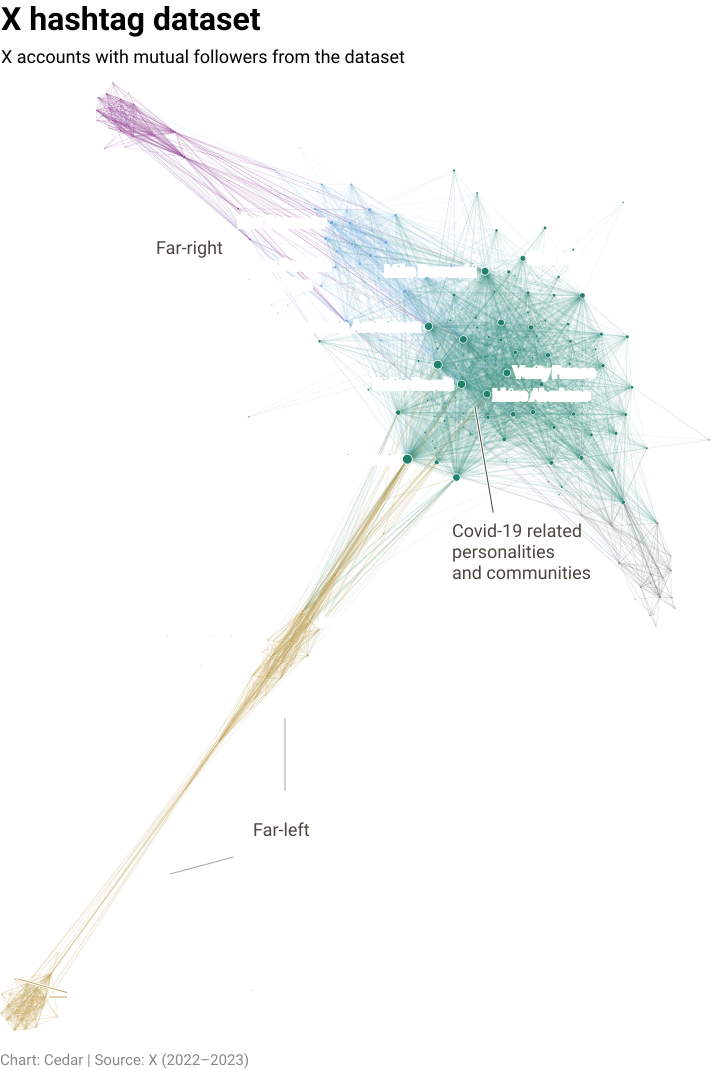
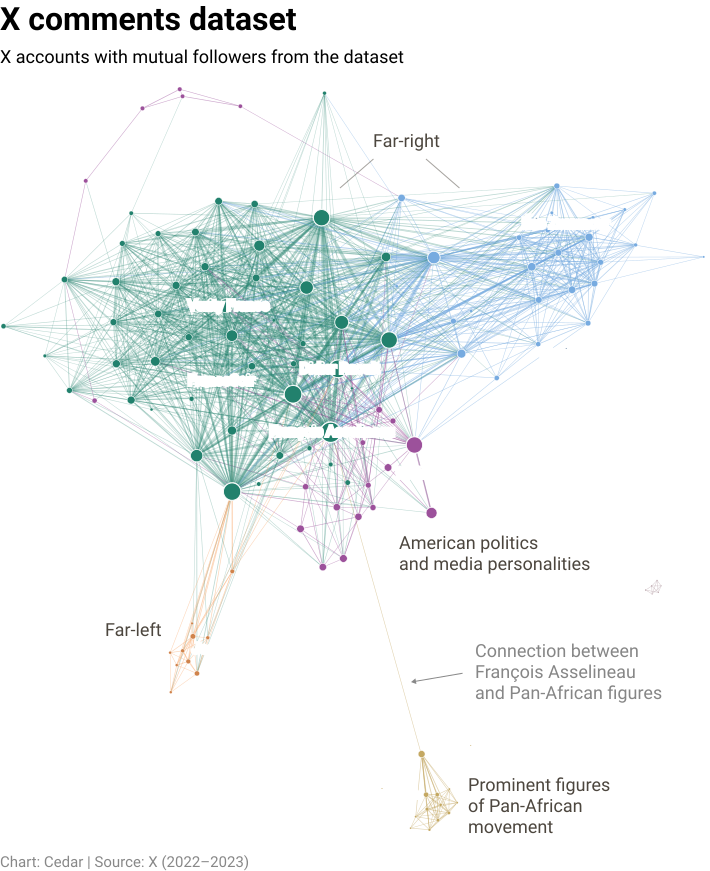
For each platform, we built a graph based on audience overlap: minimum of 5 shared followers between pages for Facebook comments dataset, 8 — for Facebook “Super Fans” dataset, and 3 — for both X datasets. In these graphs, larger nodes represent accounts followed by more people; links indicate shared followers between accounts. Clusters signal groups of users with overlapping interests.

RT’s Predominantly Male Audience

RT France’s audience is overwhelmingly male. Previous research on RT audiences worldwide (Orttung et Nelson, 2019; Crilley et al.,. 2022; Wagnsson, 2023; Saunders et al., 2022) has already noted this male dominance. Our research confirms it: for all of the social media datasets, the majority of people whose gender is known are male. Among the 63 interviewees, only five were women.

While online news audiences — and particularly those who actively commenttend to be male in general, other factors likely contribute to RT’s skewed demographics. The channel’s promotion of “traditional values” and its self-portrayal as marginalized in "mainstream" discourse appear to resonate with the so-called manosphere: networks of masculinist, sometimes openly misogynistic communities often linked to the far-right.

On X, some RT supporters signal this identity in their bios, describing themselves as “white heterosexual male, CEO, Catholic, patriot, married, father,” “an awakened white male of over 40”, “a white male and proud to be one”, a lover of “curvy women” or choosing "patriarchy" as their Twitter handle.

Far-Right, Anti-Vaccine, and Conspiracy-Oriented Communities

Network analysis of RT France’s audience shows that its followers — particularly on X — are strongly drawn to far-right politics, anti-vaccine narratives, and, in some cases, conspiracy theories. This reflects trends identified in earlier studies in France and abroad (Mattelart, 2018, Yablokov, Chatterje-Doody, 2022, Zakharova, 2023).

For example, for the X hashtag dataset, among the most followed accounts were Alexis Poulin, a French journalist who has appeared on RT and shares pro-Russian and far-right views, and Didier Raoult, a microbiologist popular within the antivax movement. Such personalities formed the largest and most cohesive clusters in the network (in violet, green and the blue one at the top left corner).

The comments dataset displayed a similar structure, with Poulin and Raoult again prominent, alongside other influential figures such as Idriss Aberkane, a controversial French media personality; Elon Musk, the owner of X; and political leaders often associated with the far-right, including Marine Le Pen, Jordan Bardella, and Éric Zemmour.

In this dataset, the largest cluster revolved around so-called “reinformation” sources — media outlets that position themselves as alternatives to the "mainstream" but often promote far-right narratives — such as FranceSoir or Mike Borowski, the founder of “La gauche m’a tuer” (The left killed me) news website. Anti-vaccine communities also featured heavily, including those centered on Raoult and on Verity France, a group that describes itself as representing “victims of vaccine side effects.” On the graph, it is represented by the central green cluster, as well as the blue one on the right.

The closeness between RT France and far-right communities is rooted not only in shared “traditional” values but also in a common feeling of marginalization and exclusion — sentiments often found within these circles. RT reinforced this perception by portraying itself as a victim of discrimination and censorship in France, encouraging audiences to see their own experiences reflected in the channel’s fate.

A 60-year-old French retiree explained: “RT is banned because it was Russian. In France, if you don’t think like the government, you're slapped with a label: far-right, antivax, irresponsible, conspiracy theorist.” For some, these feelings date back to the COVID-19 pandemic. He linked this sense of exclusion to his experience, recalling that he “was all alone in an ocean of people", because he refused to get vaccinated. Adrien, a 32-year-old French businessman, echoed this sentiment, saying he “feels marginalized” and noting that the president had declared that “if you’re not vaccinated, you’re no longer a citizen.”

Although most of RT France’s X audience clusters lean far-right, a smaller far-left presence also appears, centered on Jean-Luc Mélenchon, leader of La France Insoumise. In the comments dataset, this group forms a distinct orange cluster just below the main far-right one; in the hashtag dataset, similar clusters appear in yellow to the lower left.

The information from X hashtag dataset user profiles' bios also shows engagement with causes such as animal rights, various geopolitical conflicts (Palestine, Uyghurs in China, Kurds in Turkey), and whistleblower advocacy. Thus, many people mentioned in their profile descriptions hashtags such as #FreeAssange, #PardonSnowden, and one of the people interviewed was herself a whistleblower in France.

This diversity of political positions reflects a broader unifying factor: a shared sense of marginalization and exclusion. Even when fighting for opposing causes, participants are connected by a common narrative of being pushed to the edges of public discourse. A 46 year-old French research engineer explains the way a number of different phenomena can fit within the same narrative: “It’s a complete reuse of the narrative that was against the unvaccinated, then against the Russians, and now against people who turn on their heating.”

A Growing African Audience

Both datasets show a marked rise in African audiences on X and Facebook in the year of Russia’s full-scale invasion of Ukraine. Interviews and platform data suggest three main drivers for this shift, each echoed by the people we spoke to.

First, the EU’s ban on RT France drew new attention to the channel and, combined with a decline in French followers, sharply increased the proportion of African viewers in March 2022. Some respondents said they first learned about RT during the ban, such as a 39-year-old construction worker from Côte d’Ivoire: “When the EU began banning Russian channels, it was on LCI [a French news channel] that I saw it—that’s when I learned there was a French-language Russian channel called RT, and also Sputnik.”

Second, ongoing geopolitical tensions — particularly around the Russia–Ukraine war — spurred interest in alternative narratives, as reflected in the fact that African audience growth began in February, even before the ban. A 33-year-old special needs educator from Côte d’Ivoire recalled discovering RT “during the outbreak of the Russia–Ukraine crisis.” Research shows that transnational television channels are often more followed during crises and conflicts.

Finally, RT France made a deliberate strategic pivot toward African audiences after losing access to EU airwaves. This was evident in a new slogan — since removed from its website — “From Algiers to Cape Town – one heart, one voice for Africa”, which replaced its earlier French slogan, “Dare to question.” Also, even before the invasion, in September 2021, RT launched a program specifically aimed at African viewers — Africonnect — featuring prominent figures from across the continent. This effort seems to have earned the channel a measure of trust and respect.

The proportion of African users among RT France’s Facebook followers is far higher than on X. In the X hashtag dataset, only 9% of the 499 users whose locations could be identified appear to be based in Africa; in the comments dataset, the share is 19%. By contrast, in the Facebook comments dataset, 65% of the 2,368 identifiable users are located in African countries. The Facebook “Super Fans” dataset shows an even stronger pattern, with 78% appearing to be African.

This disparity is partly due to Facebook’s greater penetration in Africa. According to Statista, in 2022 the platform had 271 million users across the continent, compared to 22.25 million for X. Another factor is timing: most Facebook data was collected later than the X data, capturing more followers who joined after the EU ban. For this reason, our analysis of RT France’s African audience focuses on the Facebook datasets.

Visualizations of Facebook’s interest-based communities reveal numerous Africa-related pages, including country-specific clusters: Mali (blue in the comments dataset), Côte d’Ivoire (grey, to the right), and Burkina Faso (pink, to the left).

A 26-year-old liaison agent from Togo recalled his reaction when the country’s president was interviewed by RT: “I exclaimed with joy because it would allow others to become aware of the existence of Russia Today.” He noted that in December 2022, the Prime Minister was also interviewed, which he saw as proof of the country’s encouragement to follow RT “because it’s credible.” In his view, such leaders “would never have had the chance to get those interviews” with French media, which “would never give the floor to a president as devoted as ours, or to a Prime Minister as committed as ours.” He added that he values RT’s many African guests, saying he can now only hear “the truth from [his] African brothers.”

Shared values also help explain why many Africans are drawn to RT. A 28-year-old poultry farmer from Burkina Faso argued that French media “tend not to recognize the African… well… for their true worth,” giving as an example “LGBT laws,” which he felt did not reflect “the traditional African values.”

Anti-Western sentiment is another common thread. Many African followers of RT also consume Chinese state media, with the China Xinhua News Agency ranking among the most-followed Facebook pages in both datasets — forming green clusters in the Super Fans dataset and in the comments dataset. The absence of a colonial history in Africa gives both Russia and China a degree of automatic trust.

Interviewees often voiced open hostility toward “the West”: a 28-year-old Congolese journalist said it “never solved any problem” in Africa. He adds: “we like Putin, we like Russians here.” Facebook comments further illustrate this sentiment, frequently pairing declarations such as “Long live Putin” with heart emojis and African national flags.

However, a notable share of RT France’s African audience also follows established French-language state-sponsored international media such as TV5 Monde, France 24, and RFI — a trend particularly strong in the Facebook Super Fans dataset, where these outlets form a prominent yellow cluster. Several interviewees said they valued exposure to multiple perspectives and saw it as a personal responsibility to stay informed. The 26-year-old Togolese liaison officer described himself and his peers as “activists of truth.” A 30-year-old lawyer intern from the Democratic Republic of Congo expressed a similar motivation, saying he “needs access to information,” even though friends and family are often surprised at how much he spends on internet access to get it.

Pan-Africanists and the French Far-Right

Among RT France’s African followers, pan-African media figures such as Nathalie Yamb and Kemi Seba are especially popular, a pattern also confirmed in interviews. Pan-Africanism advocates for the political and economic independence of the African continent, the unity of the African diaspora, and the emancipation of Africa from Western influence and its colonial past. Russia — and RT in particular — promote themes that align with this worldview, framing themselves as counterweights to Western dominance. Kemi Seba, for example, has been invited on RT France multiple times to present his ideas. The new RT’s slogan quoted above seems to hint at pan-african ideas with its “one heart, one voice for Africa”.

What is striking is that in the X comments dataset, pan-African personalities connect to far-right audience clusters through François Asselineau, leader of the far-right Union Populaire Républicaine. Far-right politicians in France are commonly and historically associated with problematic, borderline racist views toward immigrants from African countries. And yet, it does not deter some of RT’s African audiences from following these personalities.

In Asselineau’s case, the overlap may stem from his souverainiste stance, which resembles certain pan-African ideas, as well as his outspoken criticism of French interventionism in Africa. However, some African followers also subscribe to other far-right figures. A 28-year-old Congolese journalist explained: “There’s also Éric Zemmour [leader of the far-right Reconquête party]. I’m subscribed, even though he’s far-right, because the more information I can gather — from all these personalities, bloggers, media, political figures — the better. It might be useful to me in one way or another. I don’t have limits.”

In addition to an interest in diverse news sources, traditional values appear to unite some pan-Africanists and members of the French far-right. A 28-year-old poultry farmer from Burkina Faso, who follows both François Asselineau and Florian Philippot, leader of the far-right party Les Patriotes, explained: “We place such importance on African respect, on traditional values — but these are swept aside with a wave of the hand by certain publications.”

A similar sentiment came from a 54-year-old French transport and logistics worker and member of Éric Zemmour’s far-right party, who said: “We’re trying to reclaim, in quotation marks, to bring back into focus our values, our traditions, respect — in short, all those values that we’re losing.” Such overlap is not accidental: certain pan-African principles of sovereignty and independence from external influence can at times echo aspects of European nationalist ideologies.

Conclusion

On X, RT France’s audience appears predominantly far-right, anti-vaccine, and aligned with conspiracy narratives, though it also includes a variety of political positions and causes. This diversity is bound together by a shared sense of marginalization and exclusion — a sentiment that RT actively cultivates by presenting itself as a victim of discrimination in France.

African communities are attracted to the channel for similar reasons, reinforced by RT’s deliberate outreach through African guests and topics, painful colonial past associated with some Western countries, and shared "traditional" values. These values, in turn, help explain the unexpected overlap between some African audiences and segments of the French far-right.

However, the strong presence of traditional French-language media in Africa-dominated Facebook networks suggests that these audiences are not yet lost to "mainstream" journalism — and could still be re-engaged if their voices are heard and taken seriously. Deepening the divide between these communities and the dominant public sphere would be counterproductive. A more constructive approach is to understand their perspectives and address their concerns through media outlets with greater integrity and independence than RT.